Monday, 15 November 2021
Week ending 15-11-21 farm notes:
FARM PERFORMANCE
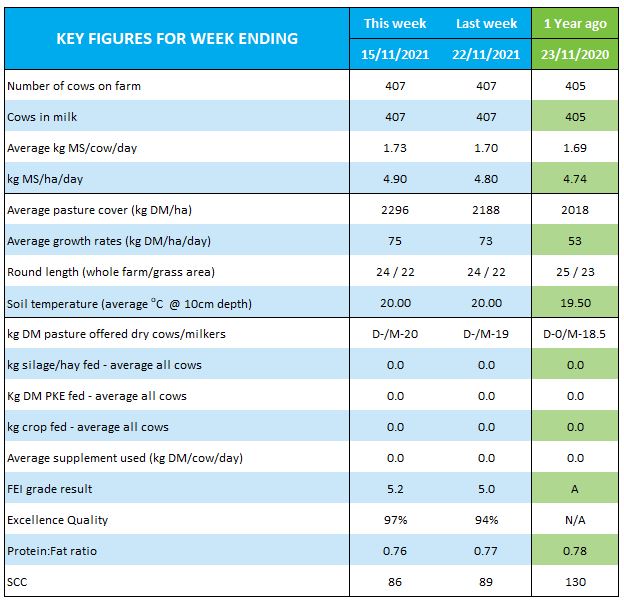
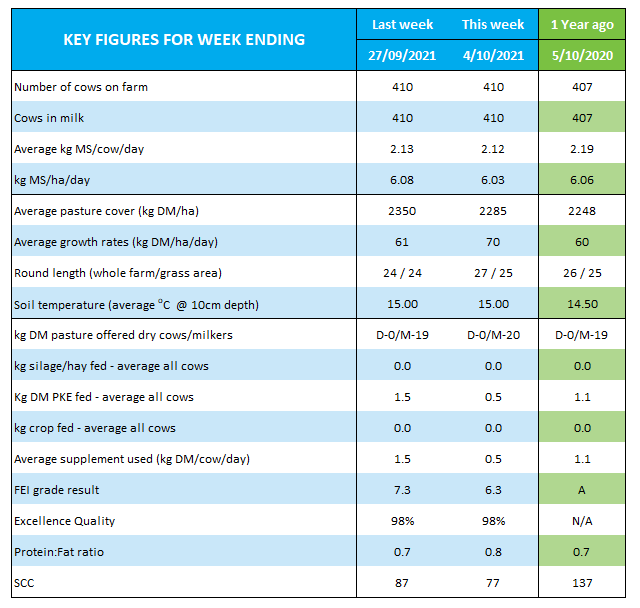
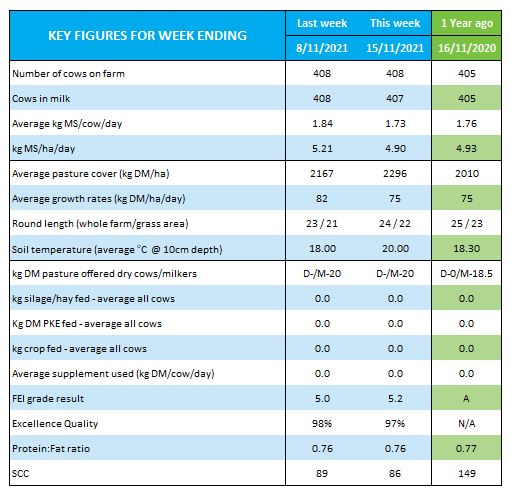
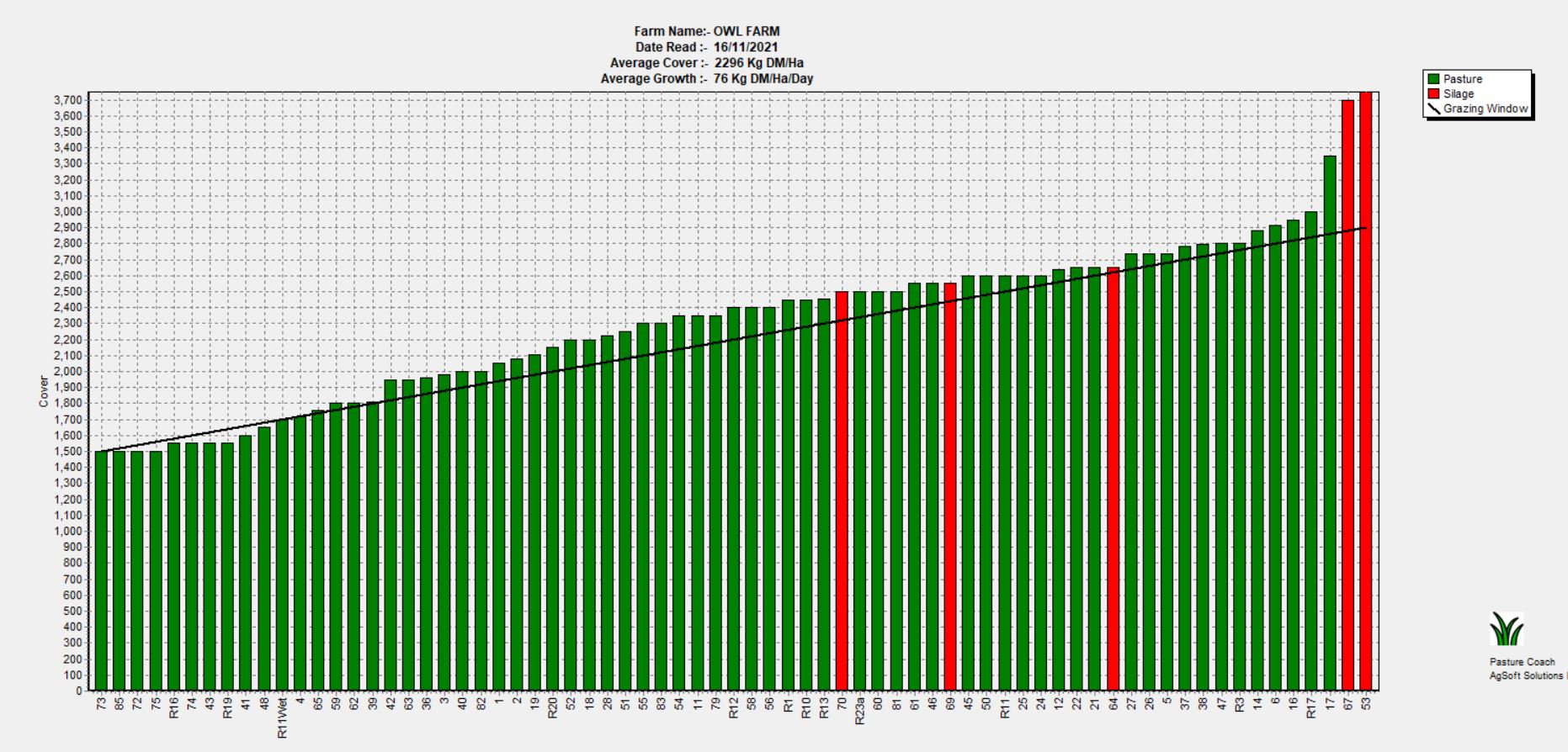
Cover increased to 2296 kg DM/ha with 75 kg DM/ha daily growth rate. Cows are still being offered 20 kg DM with a target pre-graze cover of 2800-2900 kg DM/ha but are leaving variable residuals based on weather and paddock selection. The cows are grazing 6 ha/day (including the area that the 64 weaned calves are now grazing) which is a 22-day rotation.
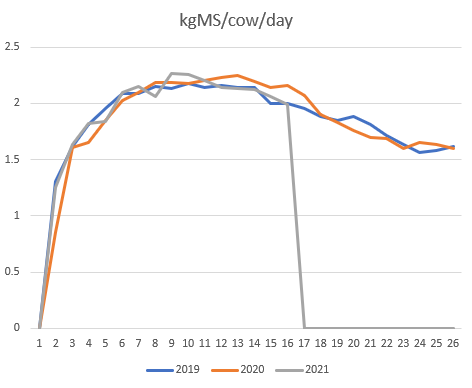
Milk production continues decline on a similar pattern to last season but tracking a week later. Milk quality excellence is at 97%.
In another 5 weeks we will transition to 3-n-2 milking frequency and start grazing turnips.
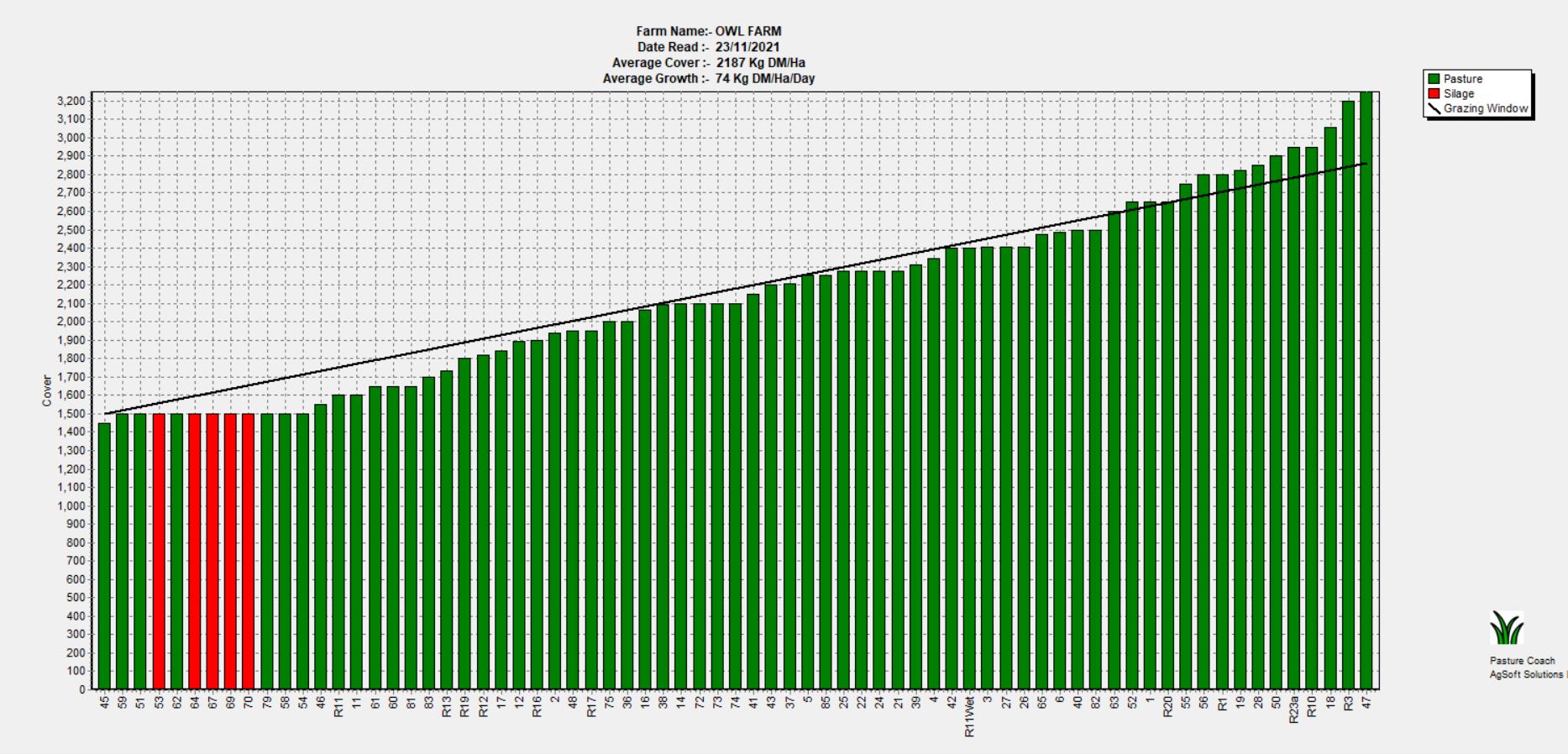
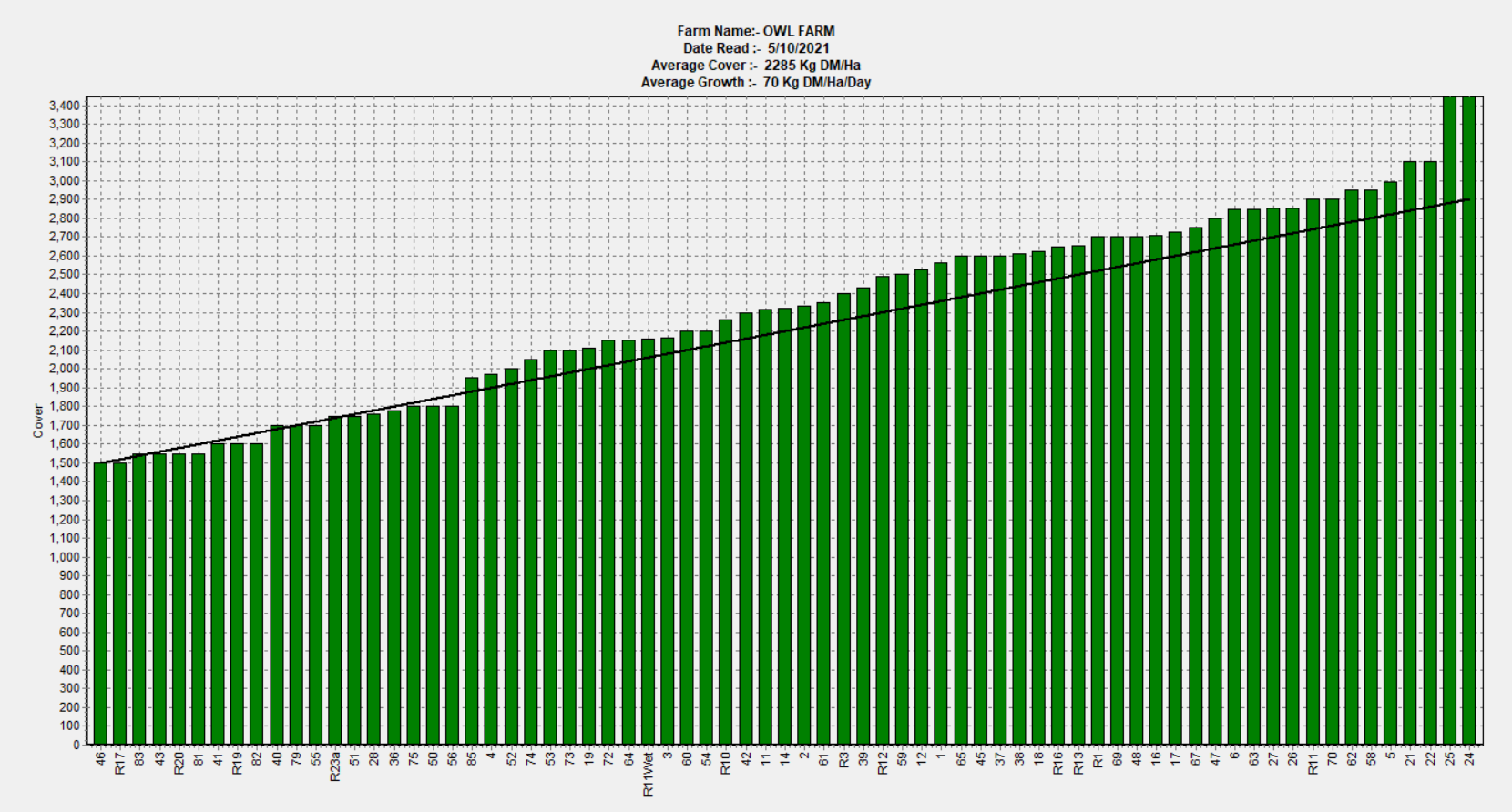
With almost 19.8 ha of paddocks previously cut for silage sitting at 2200-2400 kg DM we are selecting paddocks in the middle and top end of the wedge (shown in red), approximately 8.5ha to be cut for silage. While we will trade off yield in some paddocks it allows the cows to graze the silage regrowth paddocks quicker. With recent wet weather there is slight lag on getting silage contractors so we expect to cut in 7-10 days.
With 599 mm of rain season to date we have had 177mm more than last year. This has been favourable for good crop establishment with canopy closure of turnips now after weed and insect spray. After checking the efficacy of the weed spray, we can sit back and watch them grow - just keeping one eye on insect pressure weekly.
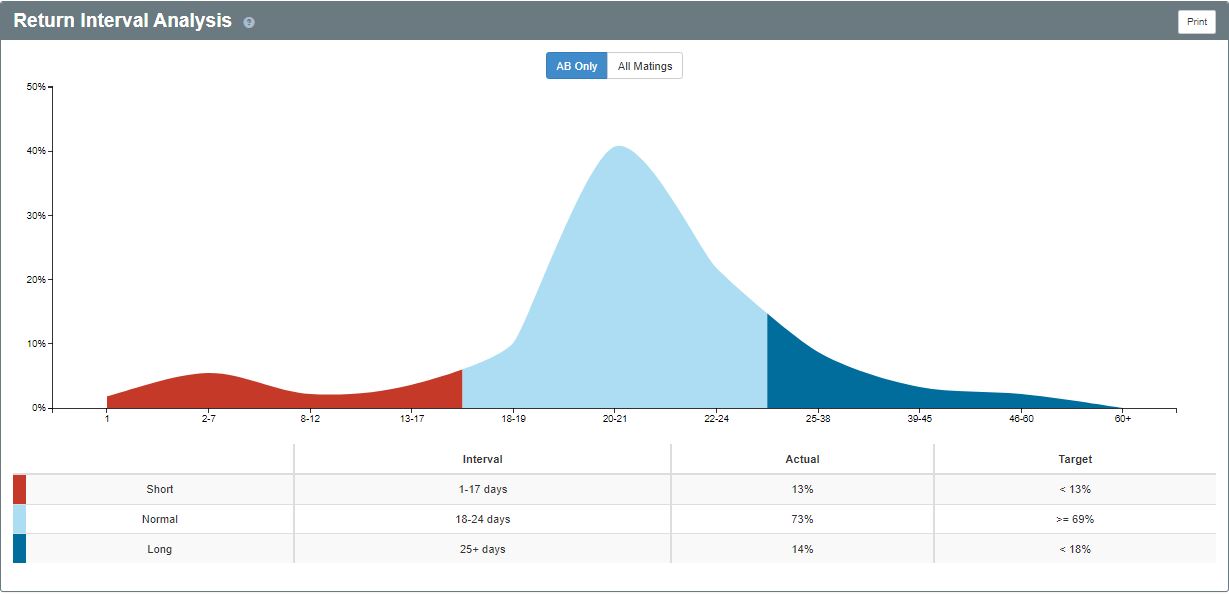
Wednesday marks week 8 of mating. Return Interval analysis from MINDA shows that our portion of short (13%) and long (14%) returns are within the target range. Non-Return Rate is sitting at 51% compared to 50% last season. This provides feedback to the team that heat detection is working well and encourages them to keep up the good work for another 4½ weeks.
ANIMAL WELL-BEING
MgO dusting has finished with cows receiving increased MgCl through the Dosatron. We are increasing from 1.5 bags to 2 bags/day as cows increase water intake, and continue to add aniseed flavouring to maintain palatability at higher concentrations. This will deliver 16 g magnesium/cow/day.
Water leaks are a constant challenge during the summer, and part of the morning routine is to check the Halo dashboard before you fetch the cows. It zeros out at midnight so should show around 500L used before the cows wake up. If it is higher than this a water leak hunt will become the job for the day, starting with yesterday’s paddocks grazed.
Cows are drinking between 60L (on wet days) and up to 110L/day. Last week with 24°C days, cows increased water intake by approximately 25L/cow. This highlights the importance of water availability as temperature and humidity increase. We look out for increases in breathing rates. Less than 7 breaths in 10 seconds is normal. Any more than that and cows are dealing with excess heat. We have not needed to use sprinklers yet. See DairyNZ to prepare your farm with management strategies https://www.dairynz.co.nz/animal/cow-health/heat-stress/
Quick reaction from the team noticing mastitis clots on the sock and then stripping the herd allows early identification of mastitic cows, which has reduced potential spread and maintained our low mastitis rates this season: 16 cows treated season to date (compared to 37 cows in 2020-21).
However, lameness cases have increased over the last 6 weeks during mating with 50 cows drafted out season to date and 8 requiring antibiotic treatment. Part of this increase in drafted cows is a lower tolerance for any sign of lameness. We are refocusing our efforts on removing stones from the yard, hosing the underpass, drafting early and picking up feet, and resting cows in the hospital mob. We have set up the GoPro again to explore animal behaviour in the yard and are working through our planned $20k of race maintenance.
With multiple users on our farm tracks we are seeing exposed stones on areas where we had implemented a short-term fix 18 months ago. You can watch us share our journey dealing with lameness https://youtu.be/2xGv1qcU8ZM
BUSINESS HEALTH
The top 20% Operating Profit benchmark is now available in DairyBase for the North Island and a top 50% for the Waikato region. We encourage you to get your results onto DairyBase as only a few more farms are needed before we can generate a Waikato top 20%. Having other farms to compare against allows us to continually learn and improve our financial performance as we create a sustainable future.
ENVIRONMENT
Students have been busy planting up the 1000 native seedlings from Trees for Survival. These spend the summer in the Ag/Hort shade house with the sprinkler set up on a daily timer ready for planting out in the winter.
Our Farm Insight Report can be found on the website https://www.owlfarm.nz/Content/upload/Documents/Nitrogen_Management_Letters_2020-2021_72847_Party_51324.pdf
It includes lots of information about performance against the co-operative difference framework, nitrogen risks, milking efficiency, lameness, mastitis and heat stress using supplier benchmark data.
DairyNZ is hosting events to help you understand the report or you can talk to your local Fonterra Area Manager to get the most from it.
QUALITY WORKPLACE
The team is motivated to get off the farm to catch up with friends and family again after 6 weeks of lock down. They have been busy planning extended leave on weekends off to suit their family and recreational needs. Hours worked this week was 174 between the team, with our season to date average sitting at 51 hrs/person/week.
COMMUNITY
Nothing to report this week.
PLANNING FOR THE MONTH AHEAD:
Cheers from Jo + Tom
Monday, 8 November 2021
Week ending 8-11-21 farm notes:
FARM PERFORMANCE
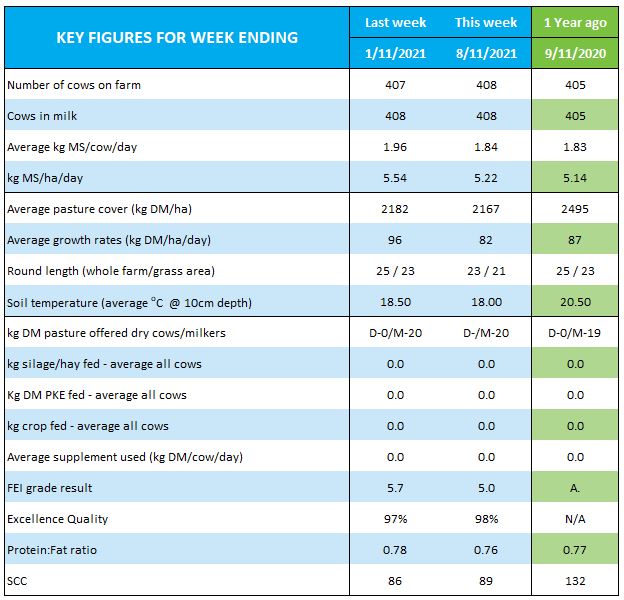
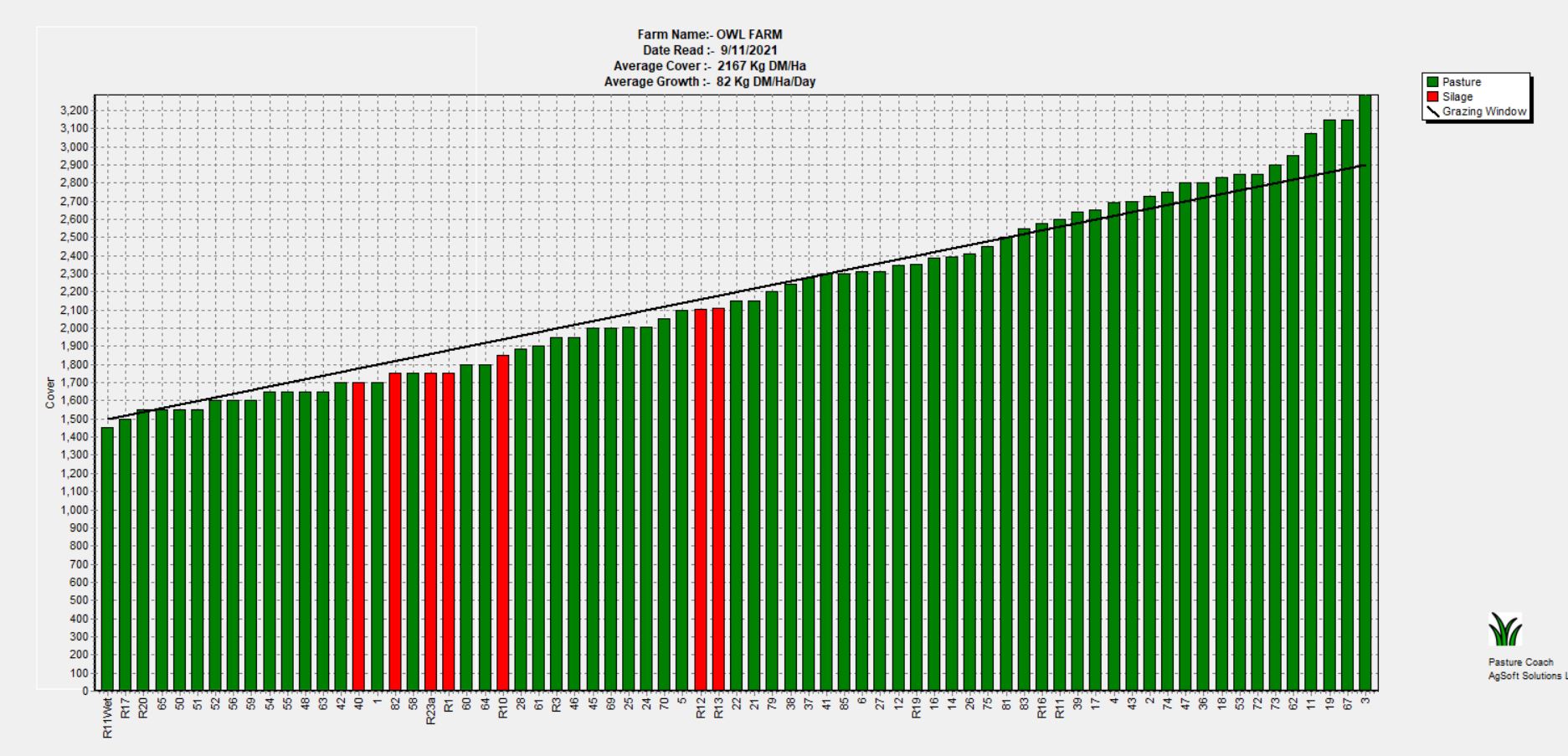
Another good growing period following rain this week. So far this season we have had 564 mm of rain vs 416 mm last season. PGR was 82 kg DM/ha/day with APC stable at 2167 kg DM/ha.
All paddocks have received their spring fertiliser (320 kg/ha SurePhos with 50 kg/ha SustaiN) to keep them growing strong.
Cocksfoot has bolted this round and we are dealing with seed heads while still having ryegrass at a tidy 3-leaf stage ideal for grazing. Pre-mowing was required for one day only this week. We have used cropping and silage making to keep APC within our target of 2000-2400 kg DM/ha. Farmax budgeting shows that we expect to take another cut of approximately 10 ha silage by the end of the month and then 4-5 ha for hay.
With all grass paddocks returned from silage we were on a 21-day rotation with a pre-graze target at 2800-2900 kg DM/ha. While we are still offering the cows 20 kg DM/day in the hope that their intake won’t be restricted, they appear to be dropping down to around 18-19 kg DM/day now. Milk production continues to decline as pasture quality reduces and temperatures increase. Cows produced an average of 1.84 kg MS/day for the week. SCC is 89,000 and we have supplied 122 days of excellence quality milk (98%).
Greg Zuren of PGG Wrightson Seeds visited to help us plan our spray programme. The chicory paddocks got sprayed on Friday with Valdo and Sequence for weeds.
The turnips and kale both got sprayed today with Sparta (insecticide), SeQuence (grass weeds) and Prestige (this is the first year we’ve included a spray for nightshade).
Because our brassica crops are close together, once we spray the turnips we spray the kale as well, because the insects will tend to move on to the nearest source of feed.
We are grateful for our relationship with Spraylink which means that they are aware of our annual spray plan and are able to get on farm quickly when the need arises.
Tom also applied a side dressing of 150 kg N/ha for both the turnips and kale.
We can now enjoy watching these crops grow and are just monitoring for a second insect spray up until the 5th December for the turnips.
The chicory will receive a nitrogen application after its first grazing.
ANIMAL WELL-BEING
The remaining 59 unweaned calves were weighed on the 4th November, averaging 108 kg. We weaned all of the calves over 105 kg (with the average weight being 114 kg) leaving 28 still on milk at an average weight of 95 kg. Each group has a progressively higher weaning weight target to help them catch up with the earlier-weaned calves. We had 14 bags of milk left to last them 12 more days before weaning, drenching then onto chicory.
Cows had individual BCS carried out on the 3rd November. Herd average was 4.5 with 2-year-olds at 4.6 and 3-year-olds our lightest group at 4.4. This is 0.1 BCS drop from the 24th September – a pleasing result during mating. Last season the herd dropped from 4.9 to 4.5 during a similar timeframe.
BUSINESS HEALTH
Nothing to report this week.
ENVIRONMENT
Did you know that St Peter’s students, with the support of Lincoln University, carried out an Ecoblitz at Owl Farm in 2015 and 2017? They discovered that over 43 bird species, 185 insects, 325 plants and 8 different mammals call the farm home. We continue to build on this biodiversity list via iNaturalistNZ where anyone visiting the farm can take a photo and get identification of a species added to our projects. Visit https://inaturalist.nz/projects/st-peter-s-school-ecoblitz-sept-2017 to see what we have found already. Maybe you could start an iNaturalistNZ project for your own farm and watch your recorded biodiversity species grow over time?
QUALITY WORKPLACE
Vaccinations and testing have become part of our work environment to ensure continued access to the farm for students. We are incredibly proud of how the team has been willing to support a return for students to the farm so eagerly in this ever-changing environment.
Big hours from the team this week with 194 hours required to weigh, sort and wean calves, make silage and spread fertiliser, along with spraying races, boundary and wetland fences.
COMMUNITY
We are gearing up to return to having farm and public visitors in mid-December, once students finish at school. At this stage we are postponing our November Focus Day to provide a series of more intimate on-farm sessions during the 16th and 17th December. More details to follow.
PLANNING FOR THE MONTH AHEAD:
Cheers from Jo & Tom
Monday, 1 November 2021
Week ending 1-11-21 farm notes:
FARM PERFORMANCE
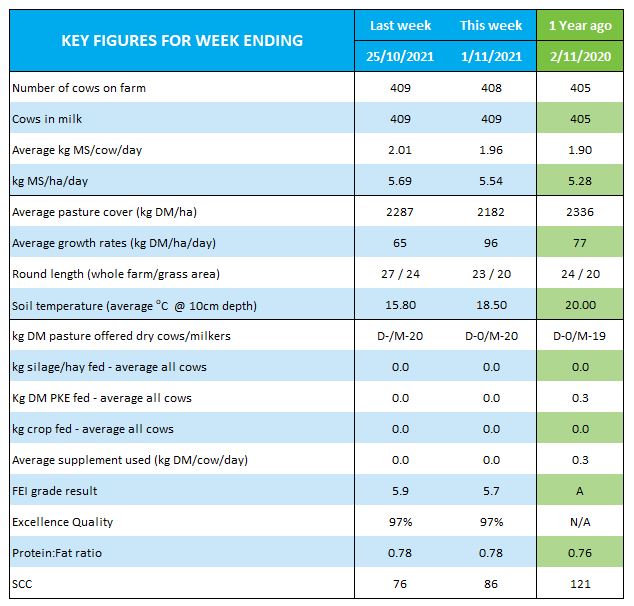
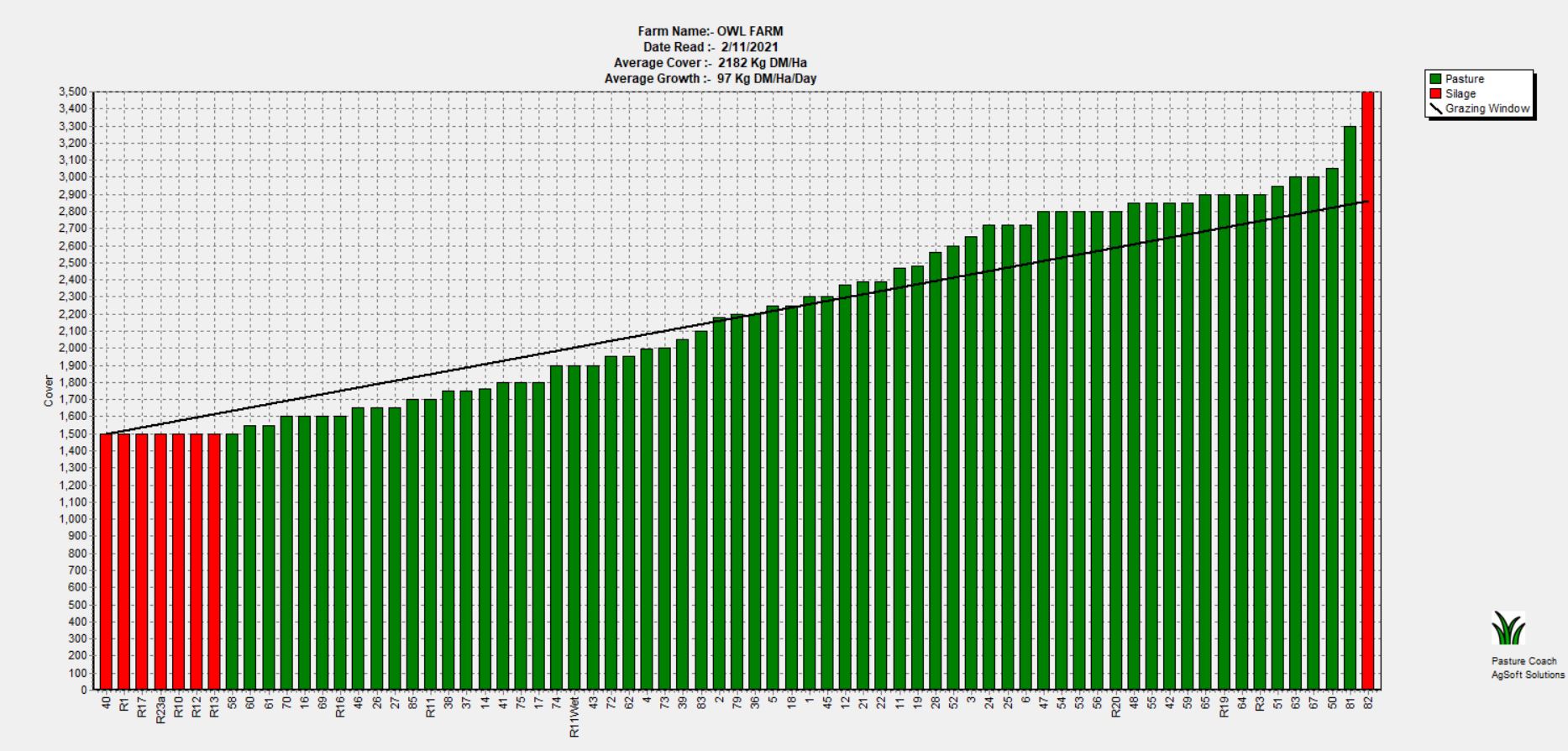
With 19.8 hectares cut for silage this week, cover has dropped down to 2182 kg DM/ha with a whopping growth rate of 96 kg DM/ha/day. We received a welcome 42 mm of rain this week (almost reaching field capacity on Friday) and plants have responded well. With all grass paddocks officially back into the rotation we return to 131.8 ha grazing platform and a stocking rate of 3.1 cows/ha.
We are still offering the cows 20 kg DM/ha/day, but with reducing ME (average 11.7) and increasing NDF (43% DM) the cows are starting to leave higher residuals. We are returning cows back to paddocks and shifting them between milkings to help clean up. We also pre-graze mow paddocks that didn’t achieve residual targets on previous grazings (approximately one-quarter of paddocks)
Half of our spring fertiliser was applied this week (320 kg/ha SurePhos with 50 kg/ha SustaiN). We use Ballance Surephos as a slow release phosphate fertiliser to ensure more is retained in the soil and less lost to the environment. We will apply the remaining spring fertiliser after the silage is picked up. This brings total N use to 70 kg N/ha. This will be the last of our spring N until late December to push cover into the summer and the remainder is for autumn recovery and new pastures.
For crops sown on the 3rd October we are aiming for roughly 30-40 turnip plants/m2. Not every plant makes it, but now that plants are at a stage where they can be sprayed with both insecticides and herbicides our technical expert Greg from PGGWrightsons will come out this week to set a spray plan based on current insect and weed pressure.
We have finished 6 weeks of mating and are still using the last of the Wagyu straws; we will then use SGL semen until the 17th December. This has the effect of reducing the gestation length by 8 to 10 days.
ANIMAL WELL-BEING
We have approximately 2 weeks of MgO left for dusting, then we will use MgCl only through the Dosatron.
Calves are on a 50/50 split of PK and Grower 20 in preparation for transitioning them onto chicory with PK and silage. This allows our 10 t of meal to last longer and keep Coccidiostat Bovatec in the diet for a longer period of time.
We have had 37 lame cows so far this season. This is higher than last season (21 cows) but better than the 111 that we had in the 2019/20 season before implementing Healthy Hoof changes. Mating puts extra pressure on cows’ feet so keeping the yard clear of stones and identifying cows early is a priority.
BUSINESS HEALTH
With Fonterra’s announcement of an increase and narrower milk price we are set to receive an extra $70k in milk income. With the increase in Nitrogen fertiliser prices we are looking at a $10k increase in product price over budget (set in March 2021).
Our PK budget was $53k for 160 t at $330/t including cartage.
We secured 120 t on contract at Fieldays for $324/t plus $17/t cartage, with 30t scheduled for each of the months July, August, December and January. We left 40t uncontracted in the hope that we could purchase cheaper on the spot market to reduce our average cost. We have purchased 17t on the spot price at $375/t plus cartage, and this week we agreed to secure the remaining 30 t at $384/t plus cartage scheduled for 10t/month. With little hope of the PK price falling, security of feed is a big risk to our production target. With a covered PK bin we can push stored feed through to February/March when we can cull empty cows to reduce demand.
So our PK spend has gone from $53k to $59k. Our purchased grass silage is 2c/kg DM more expensive than budgeted, adding another $1.6k to our feed expenses. Average cost of PK is 39.7c/kgDM and cost of purchased silage is 38c/kgDM. Not so cheap anymore!!!
Our original budget for the 2021-22 season was set at $5.21/kg MS. This is made up of baseline production system at $4.09/kg MS + $0.19/kg MS of inflated input prices + $0.67/kg MS for increasing industry standards + $0.27/kg MS for future proofing investment based on the 2021-22 payout. You can see more detail on the website here: 21-22 budget showing the breakdown of expenses
With the bulk of our imported feed and crop costs now secured, along with most mating expenses, we can now revise our budget for the remaining 6 months from December to May.
Product supply is critical this season; we have booked in our zinc for the FE season and also discussed next season’s magnesium requirements with Dom at Farm Source.
ENVIRONMENT
With the effluent area extension we have had to invest a further $1400 to install a repeater to communicate with the unit at the shed.
QUALITY WORKPLACE
Hours worked for the week was 161 with the bulk of time spent mowing. Gardens and plantings have also been tended to on the nice days.
COMMUNITY
As a school demonstration farm we are following ministry safety guidelines.
With that in mind we have made the decision to postpone our November Farm Focus Day until after school finishes in December, to ensure we can welcome you all safely back to the farm.
We will be offering multiple two-hour sessions where we can take up to 25 participants around the farm to visit cows, calves, crops and chicory, and cover off seasonal results to date. More details to follow soon.
PLANNING FOR THE MONTH AHEAD:
Cheers from Jo & Tom
Monday, 25 October 2021
Week ending 25-10-21 farm notes:
FARM PERFORMANCE
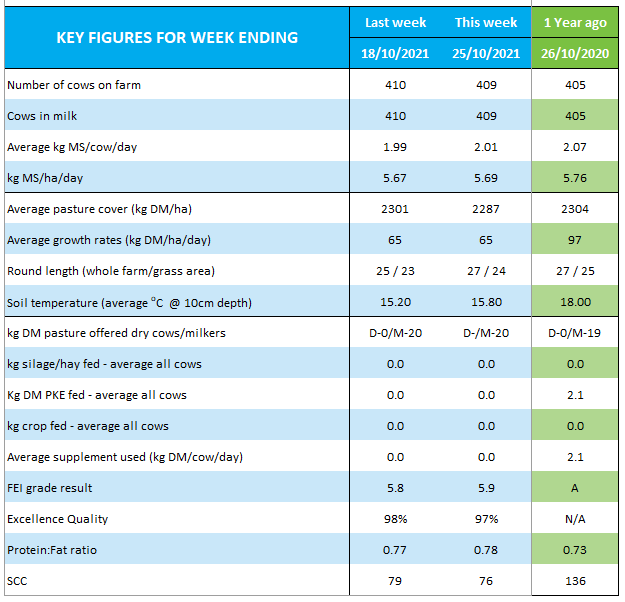
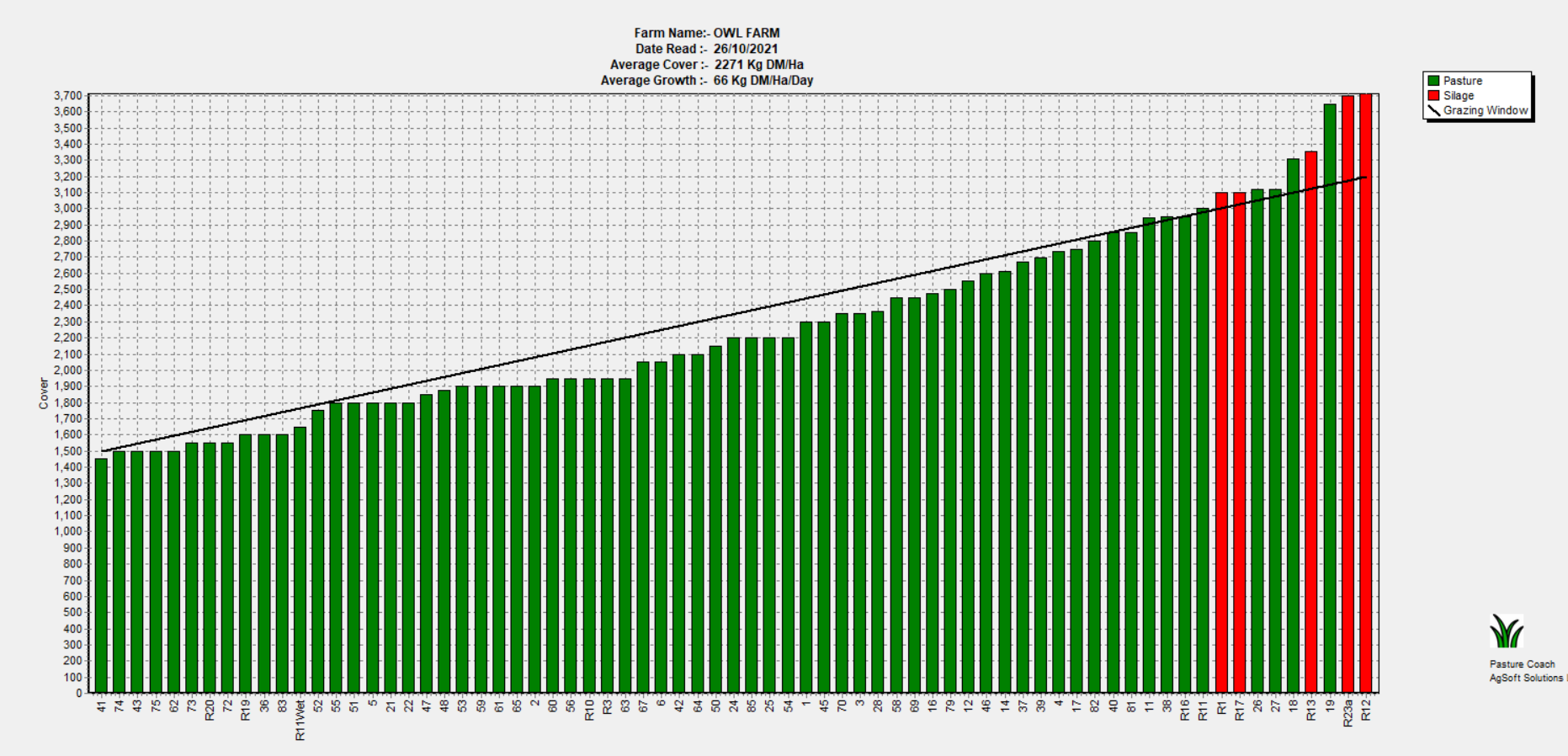
Average Pasture Cover has dropped slightly again this week with daily demand greater than current pasture growth rates of 65 kg DM/ha/day. At 2287 kg DM/ha we are still comfortably within our target range of 2000-2400 kg DM/ha. Our shut-up silage paddocks have moved to the high end of the wedge between 3100-3600 kg DM/ha with only another 1.4 ha added this week to the current 13 ha. Our rotation length on the remaining area in grazing is 22 days.
Ideally silage should be made 35-40 days after last grazing. In reality our paddocks were last grazed between 14-30 days ago by calves or a lax milker grazing. Our priority with silage is as a tool to improve the quality of feed remaining for the milking herd. These paddocks are due to be cut next week.
Encouragingly, daily milk production has lifted again back up to 2 kgMS/cow/day. We have produced 500 kg MS/ha to date with the aim of achieving 850 kg MS by the 31st December (70% of our season’s total production goal). Last year this was achieved on the 10th January. This ensures we continue to aim for a tight early calving to make the most of spring pasture production and reduce the risk of summer weather variances. We require 5.2 kg MS/ha/day to the end of the year or 1.8 kg MS/cow/day for the remaining 408 cows. It’s a lofty goal!!!!
Spring fertiliser is due to go on with 25 units of N. We will apply over half the farm next week then the remainder including the harvested silage blocks next.
Crop monitoring continues. Paddock 13 which has a lot more shade trees has had a second broadcast of slug bait, and all other brassica crops have had slug bait re-applied around the outside perimeter.
Since the crops were sown they have received 54mm of rain; but in the last 7 days we’ve only had 1.6 mm. We have found early signs of leaf miner and spring tail damage. The damage at the moment is not critical so we will try and hold off for more rain and continued seed germination for plants to reach the critical 3-4 leaf stage. This allows us to combine an insecticide with the grass weed spray (SeQuence) to reduce the amount of passes through the crop and spraying costs at $42/ha for the contractor.
Chicory crops have not required any more slug bait yet, however they will require Valdo/SeQuence herbicide to control wireweed and grasses.
ANIMAL WELL-BEING
The handful of cows that were being monitored for signs of Theileria have now returned to their herd mates after being checked and being within normal limits against the F.A.N.I. card. They will continue to be observed for improved health status before returning to Twice a Day milking frequency.
Two more cases of lameness this week. The majority of cows are being diagnosed white line, a bit of footrot and stones getting stuck in claws.
We have just finished our first full week of Wagyu-only mating, with only ten cows left to be mated.
The first mob of calves were weaned last week at weighing. Calves weighed an average of 103 kg (range 83-138 kg) on the 20th October. They have gained an average of 767 g/day since their last weighing 42 days ago. They require gains of 580 g/day until PSM to reach their goal of 303 kg (end goal 484 kg at PSC). Seven calves are underweight, and one calf is in the action mob. Calves received boosters for 5n1 and lepto along with Arrest C worm drench today. 30 calves over 105 kg have been weaned now.
The next mob of 30 was created weighing 95-105 kg and they will be weaned at 115 kg in approximately two weeks’ time after their next weighing. The remaining mob of 85-95 kg will be weaned in mid/late November, or whenever we finish the last of the milk replacer!
The calves will get one more Arrest C worm drench before going onto chicory.
BUSINESS HEALTH
Cashflow updated to the end of September can be found here: https://www.owlfarm.nz/financials/farmbudgets
Cash surplus after finance costs is tracking $66k ahead of budget. While we are still behind in production compared to budget, income is $98k ahead of budget. Milk income is $66k over budget, and $27k in cattle sales which is just timing relative to budget. Farm working expenses are $306k to the end of September. Genuine unbudgeted expenditure includes milk replacer for calves of $5.7k, increase in fertiliser costs approx. $6-$10k by year end, extending silage bunker $4.7k, cycleway re-fence projects $1.7k and increases in water charges. With the increase in payout mid-point to $8.40/kg MS from Fonterra and the bulk of our seasonal purchases being made in the next 5 weeks we will look to revise the budget at the end of November to allow informed decision-making through summer and autumn.
ENVIRONMENT
Planting checks continue to salvage plants that the pukekos have been pulling out alongside the drains. Approximately 5-10% require replanting, along with some that just need to be heeled in to secure them nicely while the soil is still moist enough.
QUALITY WORKPLACE
Total hours worked this week by the team was 187 hours. It has been feeling a bit like ground hog day in L3 lockdown without things to look forward away from the farm on days off. Currently the team are happy to carry on at work (where there are people to talk to) with extended lunch breaks to catch up on town jobs. With annual leave being accumulated this will have implications for ensuring the team get extended periods off the farm when Covid restrictions allow.
COMMUNITY
Nothing to report this week.
PLANNING FOR THE MONTH AHEAD:
Cheers from Jo + Tom
Monday, 11 October 2021
Week ending 11-10-21 farm notes:
FARM PERFORMANCE
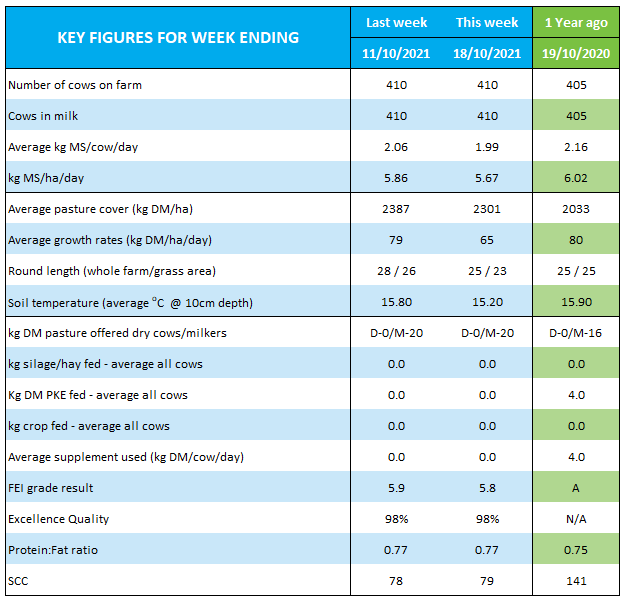
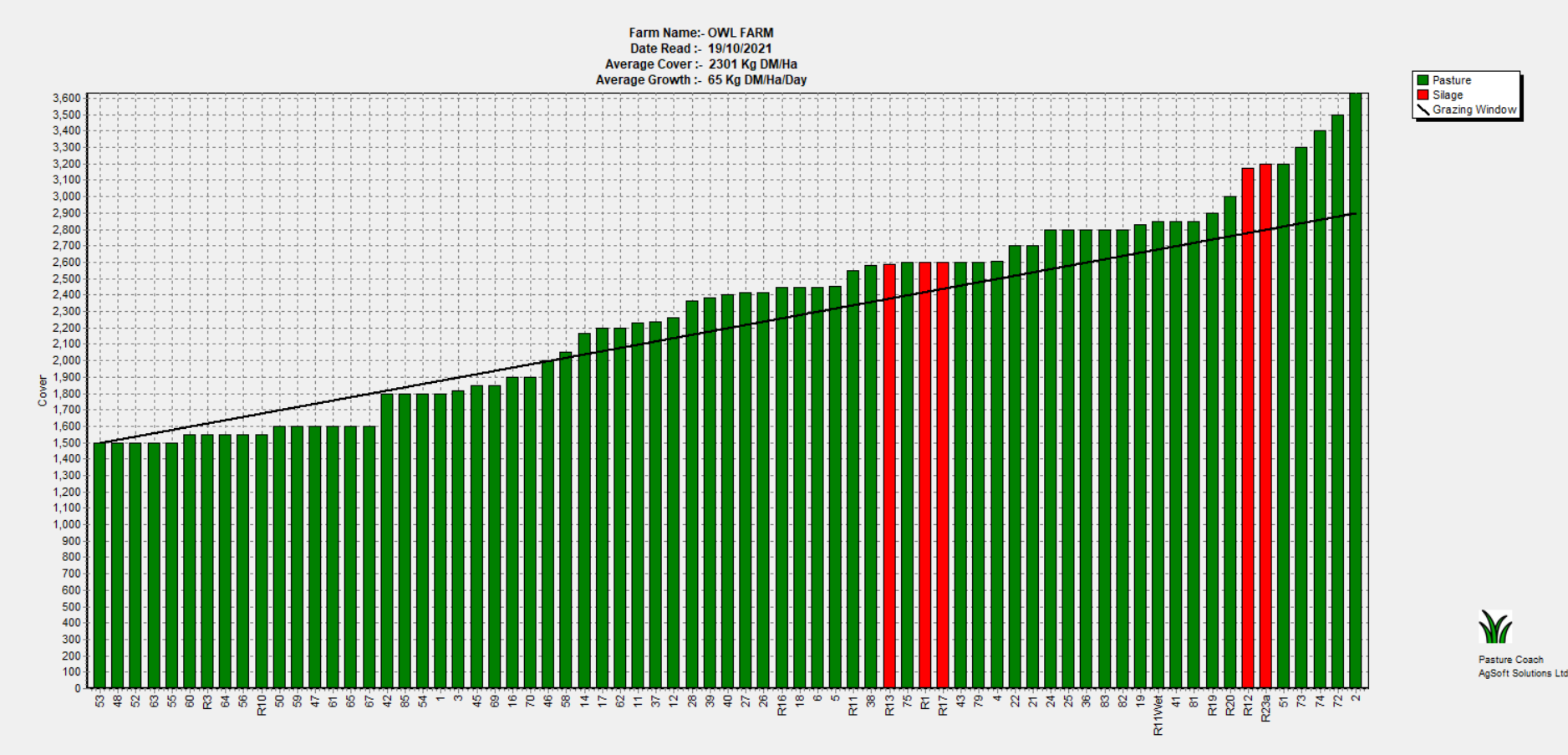
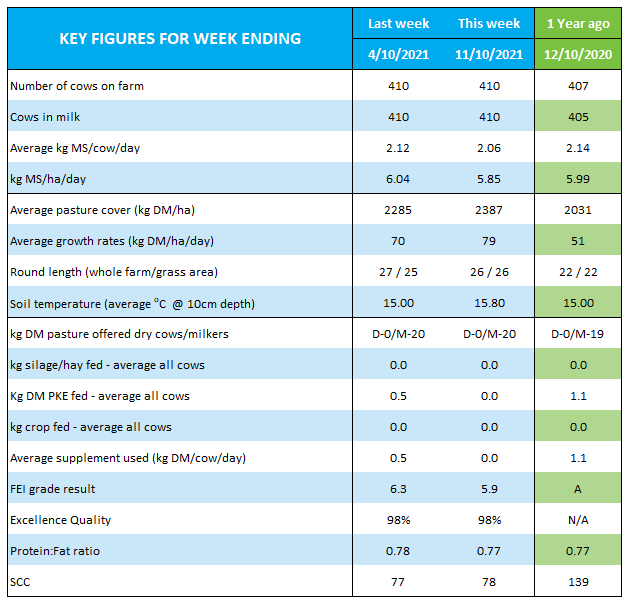
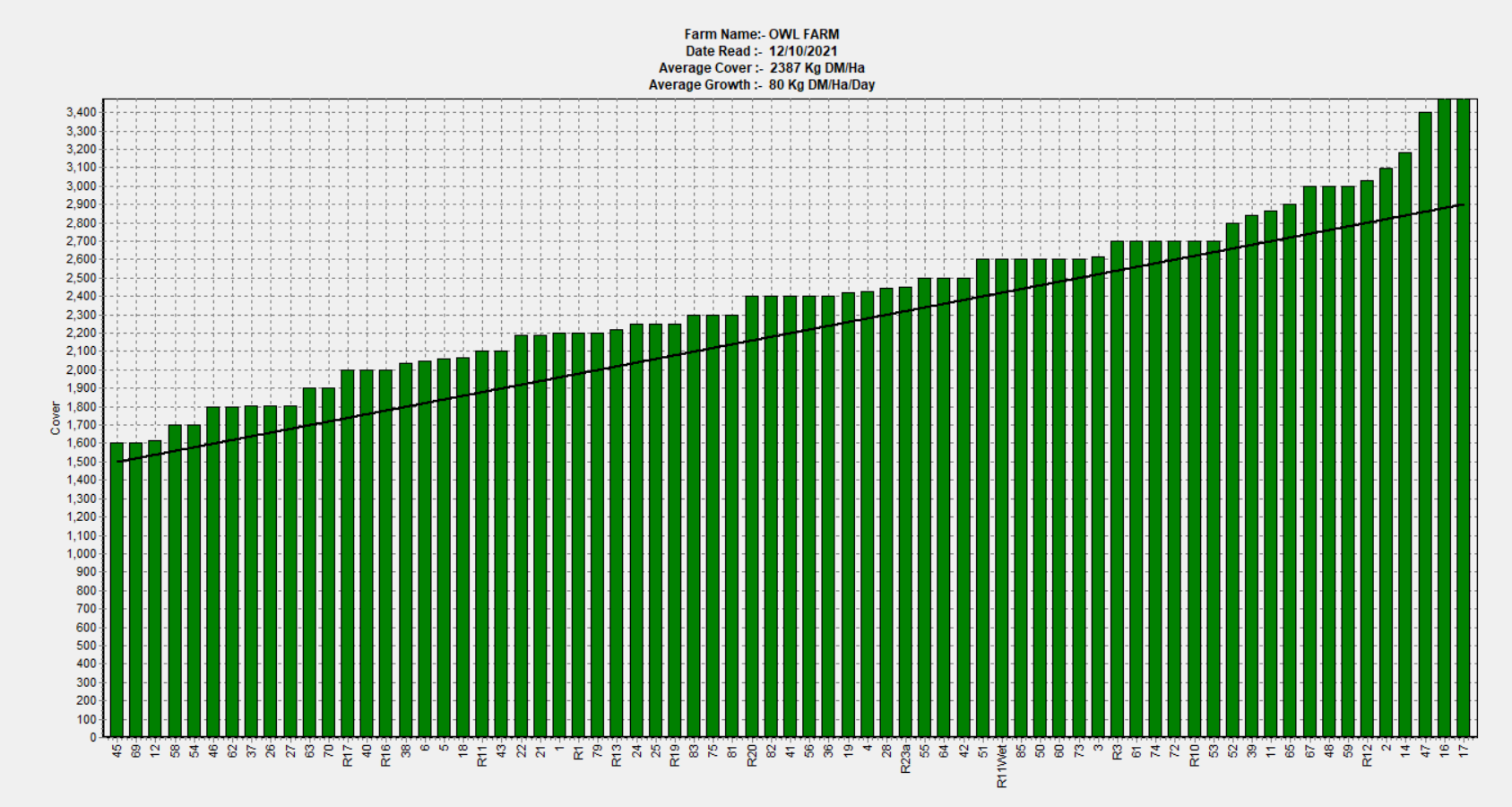
Pasture Growth Rate (PGR) continues to climb this week to 79 kg DM/ha/day. Average Pasture Cover (APC) increased to 2344 kg DM/ha. At Owl Farm we aim to keep APC between 2000-2400 kg DM/ha to maximise pasture production. Early identification and timely silage making is required to maintain quality feed for the milking cows. With current growth rates we only require 109 ha to feed the milking herd. This is equivalent to removing 22.6 ha of the area for silage and has the effect of increasing stocking rate to 3.76 cow/ha and lifting pre-graze cover to 3200 kg DM/ha, grazing 4.95 ha/day which maintains a 22-day rotation on the grazing area. With paddocks being previously well grazed we can still offer quality feed at this pre-graze cover during October. This allows us to identify suitable paddocks that will be ready to cut for silage in approximately two weeks. Paddocks that had a wet weather grazing or poor residuals, paddocks with good contour and accessibility for machinery, paddocks that are mature and well established (> 1 year old), are currently around 2100-2500 kg DM/ha cover in the bottom half of our feed wedge.
Milk production is slowly declining from its peak of 2.27 kg MS/cow in early September to 2.06 kg MS/cow/day a month later. We have had more than 10 weeks of production at over 2 kg MS/cow/day with 98% excellence quality and SCC sitting around 60-80,000. Milk production is 1% ahead season to date, and 1.8% ahead month to date.
Cows are being offered 20 kg DM/cow/day (pasture) with no other supplements.
Cows in the hospital mob or waiting for insemination have access to PK in the paddocks close to the shed.
Brassica crops are germinating and each crop paddock has a slug monitoring station using carpet squares and crushed Weetbix for bait. These paddocks are being checked twice a week. We are finding around one slug under the carpet per eight paddocks checked at the moment, with no visible slug damage. This indicates the initial slug bait (5 kg/ha) broadcast at sowing is working and we expect to need more bait again next week, approximately two weeks after sowing.
Mating continues to go well, with 91% of all cows submitted for mating after three weeks. Industry target is 90%, and last season we achieved 88%.
With Tom having a well-deserved break this week off farm the team are well supported to continue identifying cows to be mated. We budget $5k annually for heat detection aids and fresh tail paint. We use LIC’s Heat Patch Plus which cost $2.80 each, are self-adhesive and allow the dye to bleed to the edge of the patch over time to indicate the length of time a cow has been on heat. Investing in Protrack for accurate drafting means that the team have the facilities and skills to select cows while bringing them in to the yard and at cups-on using the tail paint mirror. Our policy of “if in doubt draft her out” buys time to observe, look at data and make a decision on whether to mate a cow each day.
ANIMAL WELL-BEING
Calves are shifted every two days into a fresh paddock. Daily each mob gets 80 kg Feed Grower 20% and 20 kg PKE (offering around 2 kg meal/calf/day). Old meal is cleaned out and recycled to the hospital mob to ensure calves have fresh meal every day. Maintaining a clean calfeteria every day is also important for optimum calf health.
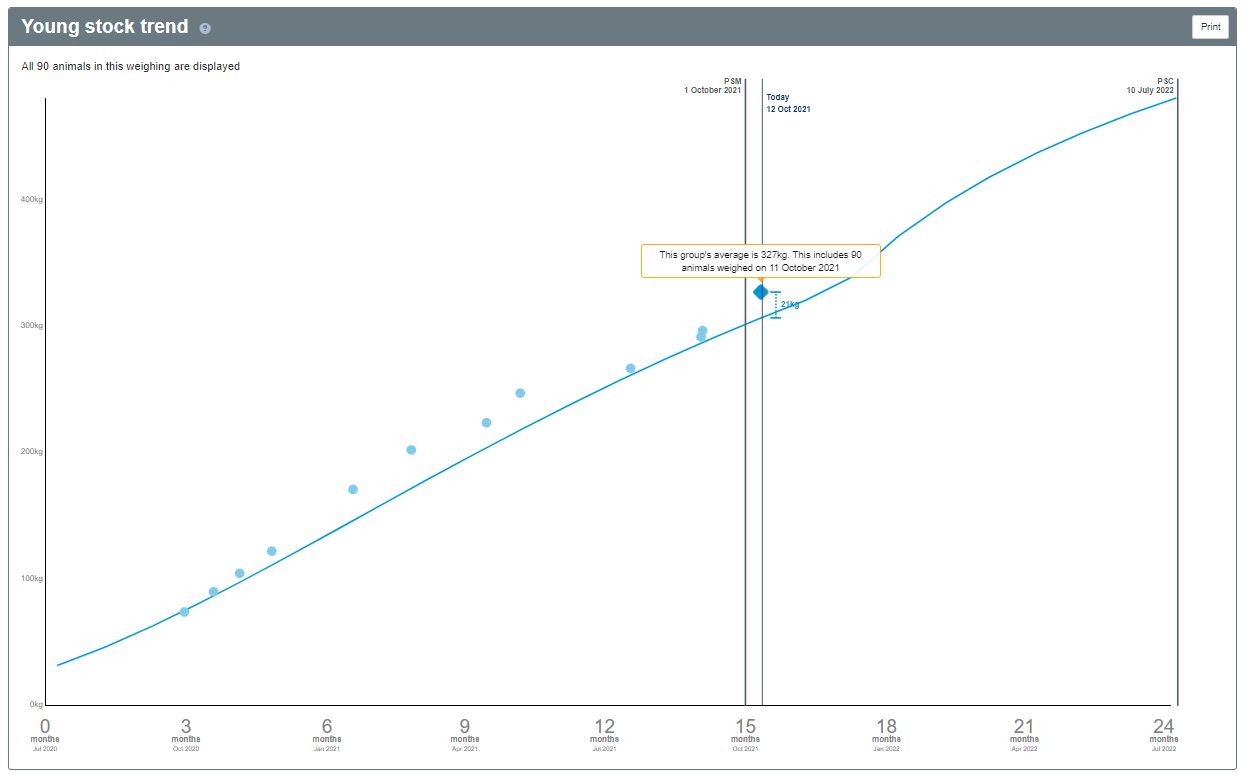
Our 90 rising 2-year-olds out grazing weighed 327 kg (range 282-382 kg) on 11th October. This is 21 kg above target weight with only three animals now underweight compared with eight in September. These heifers gained an average 0.9 kg lwt/day since 3rd September and require liveweight gains of 0.56 kg/day to reach target weight at calving.
BUSINESS HEALTH
Nothing to report this week.
ENVIRONMENT
We have taken the time before crops were drilled to empty slurry onto some paddocks. It’s been important during the wet September/October period to ensure that the underpass sump has been working to contain effluent washed down and the high volume of rain going through it. A well-drained underpass also helps reduce issues with lameness.
QUALITY WORKPLACE
Great news on the new 2021 Resident Visa that the government announced recently. This provides a pathway for LaArni to secure her and her family’s future in NZ after four years of commitment to both Owl Farm and the dairy industry in NZ.
As a school/demo farm it has been our priority to ensure a safe workplace for visitors to the farm. This also includes keeping up with government advice around COVID best practice management. As a team we have provided support and flexibility to allow team members to get vaccinated, given them time to make appointments and provided light duties afterwards to ensure a speedy recovery and return to work. A staggered approach worked best for our team as we are close to vaccination centres.
We have discussed what the process would be on farm if a team member did contract COVID and how the team would cover the workload. DairyNZ has some business continuity resources and an informative webinar available on their website. https://www.dairynz.co.nz/business/adverse-events/coronavirus-covid-19-information/supporting-your-team-on-farm-during-covid-19/
COMMUNITY
Tonight we join the DairyNZ Wednesday night live session on youngstock management to share our journey on monitoring and managing replacement heifers. Join the link below from 7-8pm.
https://dairynz.zoom.us/j/2176561353?pwd=cmlDMHRidUQ0dzJTcklBTGR5Z3RGQT09
PLANNING FOR THE MONTH AHEAD:
Cheers from Jo + Tom
Monday, 27 September 2021
Week ending 27-9-21 farm notes:
FARM PERFORMANCE
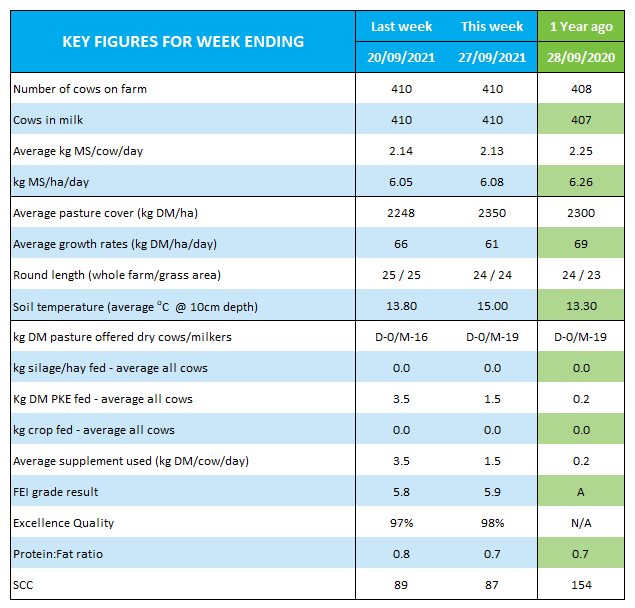
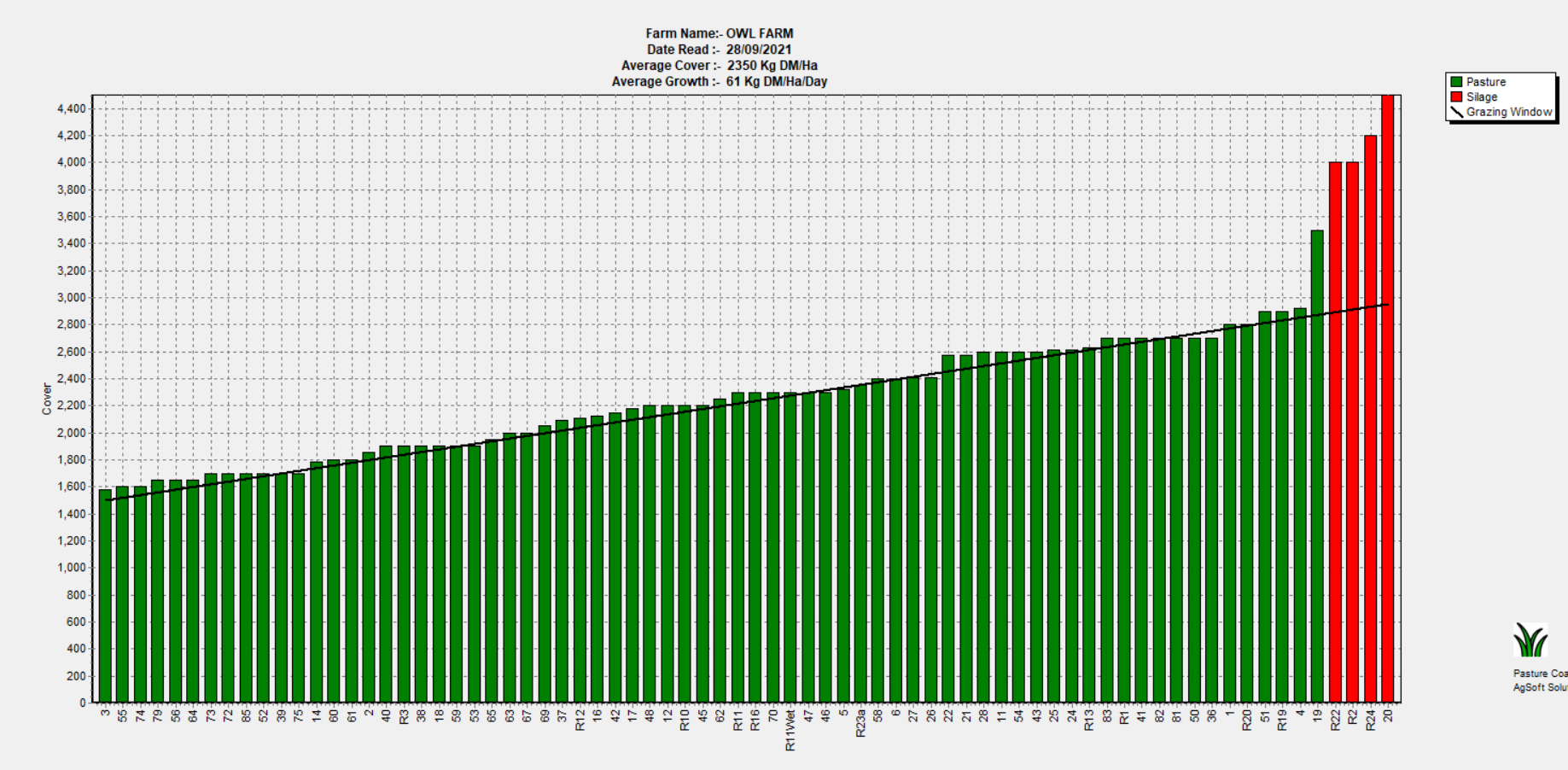
PGR of 61 kg DM/ha/day this week and a lift in cover to 2350 kg DM/ha including our silage paddocks. APC is 2234 kgDM/ha without silage paddocks.
We averaged 19 kg DM/cow/day pasture offered plus 1.5 kg PK/cow/day for the week. The cows are holding at 2.1 kg MS/cow/day. Milk production is 2.9% ahead month to date and 0.7% ahead season to date. We have supplied 98% days of excellence from 83 days of production.
Pre-graze targets are back up to 2800-2900 kg DM/ha/day and PK won’t be needed this week. Cows weren’t eating what was being offered by the end of last week anyway. FEI peaked at 7.6 at the end of this week which was enough to trigger an alert even with cows eating such low levels of PKE.
Third and last metri-check completed, with four cows treated. 25 cows in total this season (6% of the herd).
Mating started on the 22nd September and we have inseminated 181 cows after 7 days (25 cows/day). We require an average of 17 cows/day to meet 90% 3-week submission rate.
We budget $2153 for repro intervention and this year we have spent approximately $1900 on CIDRs for 28 cows (6.8%) that had calved more than 42 days and not had a pre-mating heat, and a PG shot for 100 cows that had a cycle in the week prior to mating. Six years ago we were CIDRing up to 140 cows. Last year we CIDRed 27 cows with no PG used. CIDRs went in on the 23 September and cows will be mated 30th September - 1st October.
For the PG cows the first 60 that cycled 5-7 days prior to PSM received a PG shot on the 22nd September. The remaining 40 cows that cycled 1-4 days prior to PSM received a PG shot on the 27th September. This has the effect of mating these 100 cows in the first two weeks of mating. We don’t use sexed semen on these cows and still have enough cows coming up to fill our daily quota of 8 sexed semen straws/day on high BW cows.
All heifers have been mated and are now running with bulls.
Crop paddocks were sprayed with Glyphosate on 19th September, and annual paddocks will be cut on Thursday and ensiled on Friday. The remaining paddocks have all been grazed. We tried pre-mowing some of the sprayed paddocks to see if the grazing resulted in a cleaner paddock but found up to 8 slugs/m2 under the clumps left behind. That’s up to 80,000 slugs munching away at our new crop seedlings!! With slug numbers reported to be higher this year we happily spend $70/ha on slug bait by applying 5 kg/ha after final graze and 5 kg/ha at sowing. For some paddocks we will apply up to 20 kg/ha of bait depending on monitoring data (the sack or log in the paddock that we check under).
ANIMAL WELL-BEING
So far this season we have had 24 lame cows, and 11 cows treated for mastitis. With zero deaths and eight cows treated with milk fever, one RFM and 25 cows with metritis, we consider the cows to be in good health. We recorded our lowest ever SCC pick up of 60,000 yesterday - a testament to the hard work the team is putting into our <150,000 SCC target for the season.
Whole herd BCS was carried out on the 24th September with an average BCS of 4.6, down from 4.8 at the beginning of the month. Seven cows are below BCS 4; we have checked these out. Five cows are being milked OAD at the moment (all in the small herd). Heifers average BCS 4.8.
Cows continue to receive selenium, cobalt, copper, zinc, iodine and magnesium chloride in the Dosatron, and magnesium oxide via paddock dusting.
BUSINESS HEALTH
Nothing to report this week
ENVIRONMENT
Year 8 St Peter’s Students helped us plant out over 1000 plants from the school’s Trees for Survival programme. Using a handy Makita hole borer and having the plants laid out ahead of the students made for a very effective two hours of planting. We have been lucky to receive a donation of 280 plants from Karapiro school that we will plant up along another drain where they will be able to see them when the cycleway opens at the beginning of next year.
QUALITY WORKPLACE
Mental Health Awareness week is about taking time to korero. Farming can get hectic but Tom and I have a weekly routine of clearing our diaries every Tuesday between 10-2pm to carry out the farm walk and process the data for the week. It’s during this time that we chat about our aspirations for the farm but also for ourselves and our families. We try to solve the problems of the world and also provide a listening ear to each other’s frustrations. It’s a time to be present and listen, every now and then I miss a piece of data but I can always get it later. Taking care of our mental health can’t wait.
COMMUNITY
The last of our Wednesday weekly catch-ups is about our experience of using the Healthy Hoof process to manage the high rates of lameness (34% of the herd) we experienced in the 2019/20 season. By implementing a few significant changes this was reduced to 15% in 2020/21.
Join us at 11am https://us02web.zoom.us/j/86273812669 or catch the recording on FaceBook live or You Tube later on in the week.
PLANNING FOR THE MONTH AHEAD:
Cheers from Jo & Tom
Monday, 20 September 2021
Week ending 20-9-21 farm notes:
FARM PERFORMANCE
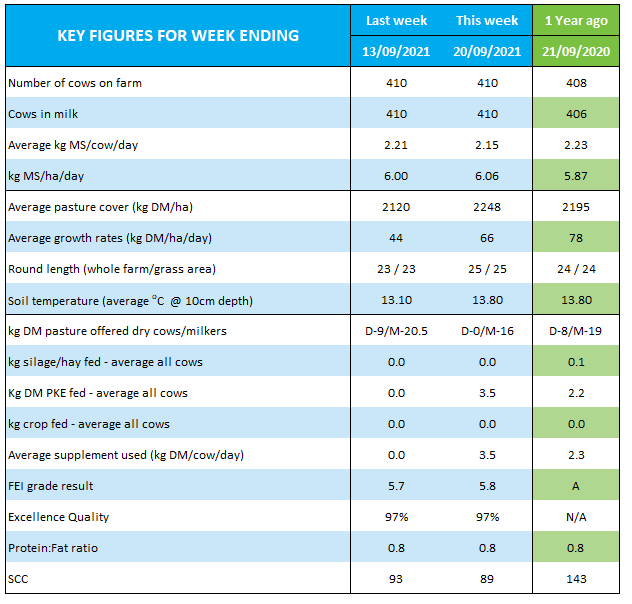
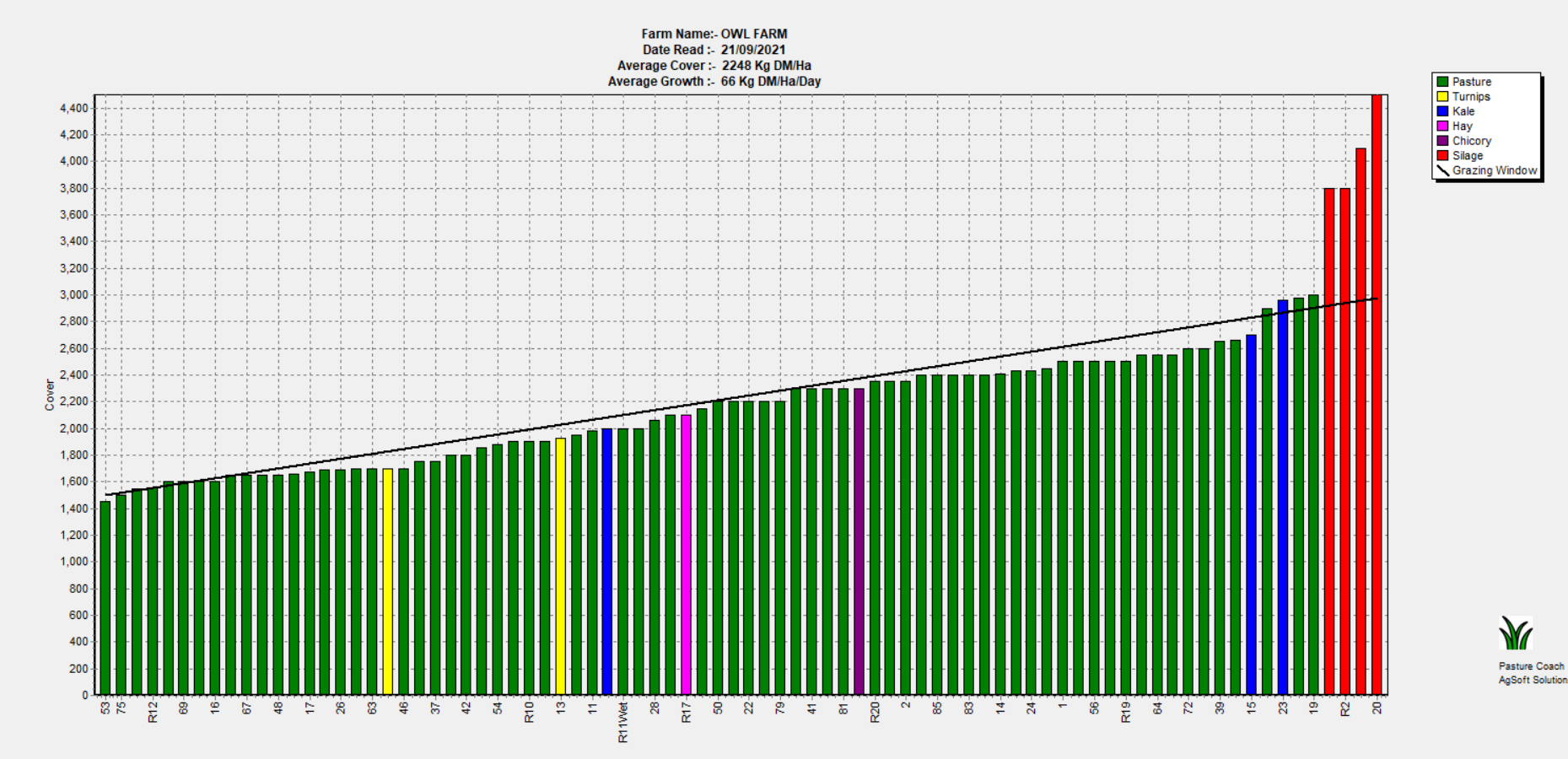
After 2 wet weeks and delayed growth rates we were pleased to see that APC lifted to 2248 kgDM/ha with a growth rate of 66 kgDM/ha/day. Our APC includes 8.2ha of annuals that are over 3000kgDM/ha that are due to be ensiled before going into crop. Removing these silage paddocks to show the grazeable pasture on farm drops our APC to 2128 kgDM/ha.
On Sunday we roundup sprayed 12ha of the farm plus the support area for calves on Chicory. Non annual crop paddocks will be grazed by the cows before direct drilling. The aim is to clean these paddocks out before drilling to reduce slug pressure on germinating seedlings. Planting date for all crops is planned for 1st October.
With lower pre-graze covers this week we filled the gap with 3.5kgDM PK. This lifted our FEI from 4.8 with no PK to 6 (which is still well within the threshold of 9). Total feed offered dropped to 19.5kgDM/cow/day but residuals and cow behaviour showed us that cows were content. Cows have started leaving the PK preferring pastures and as our pre-graze covers increase to 2700-2900 kgDM/ha we are reducing the PK offered down to 1kgDM/cow/day for this week. Still targeting minimum 20 kgDM/cow/day offered. We have enough PK in our bin but have been warned of up to 9 day waits on PK deliveries. Our cows require intakes of 18.7 kgDM high quality feed to meet energy output and more to be gaining BCS.
ANIMAL WELL-BEING
We have had 69 mm of rain so far in September more than all of September last year. September is the highest rainfall month of the year with average rainfall of 131mm. This has caused a spate of lameness with 10 cows drafted out to rest or treat this week – bringing our season to date total to 26 cows.
We had 130 non-cyclers on 15th Sept. Out of these 52 were late calving cows (calved less than 42 days)
As at the 22nd September we still have 38 cows on our watch list still to cycle that have calved more than 42 days. CIDRs are due to go in 23rd September on a select group of these cows.
Heifers have been synchronised and mated on the 20th and 21st for the two mobs out grazing. Cows have all had fresh tailpaint with green indicating cycled cow, blue indicating calved less than 42 days from PSM and yellow a non-cycling cow. Cows start mating 22nd Sept which is a 1st July PSC.
Cows are still receiving MgCl (5g Mag/cow), Zinc and bloat oil via the dosatron and paddocks get dusted with MgO (13-15g Mag/cow) ahead of the cows.
Colostrum milk has all been used and replacement heifers are on 80% formula/20% vat milk mix. They are being rotated around the farm 2 days per paddock and the second mob of calves have just ventured outside.
BUSINESS HEALTH
After the first 3 months of the season we have spent $210,464 and produced 25,252 kgMS.
LIC dividend received earlier than budget, and increases in payout since budget was approved in March, show an increase of $68,023 income season to date. Timing of expenses including purchasing all Mg at the start of the season (which provided very valuable due to shipping delays), fertiliser timing relative to budget and increase in product price, and the decision to use milk replacement powder instead of milk from the vat have all increased expenses season to date by $30,093. Surplus is tracking $36,501 ahead of budget season to date. Our full actual to budget cashflow can be found https://www.owlfarm.nz/financials/farmbudgets
ENVIRONMENT
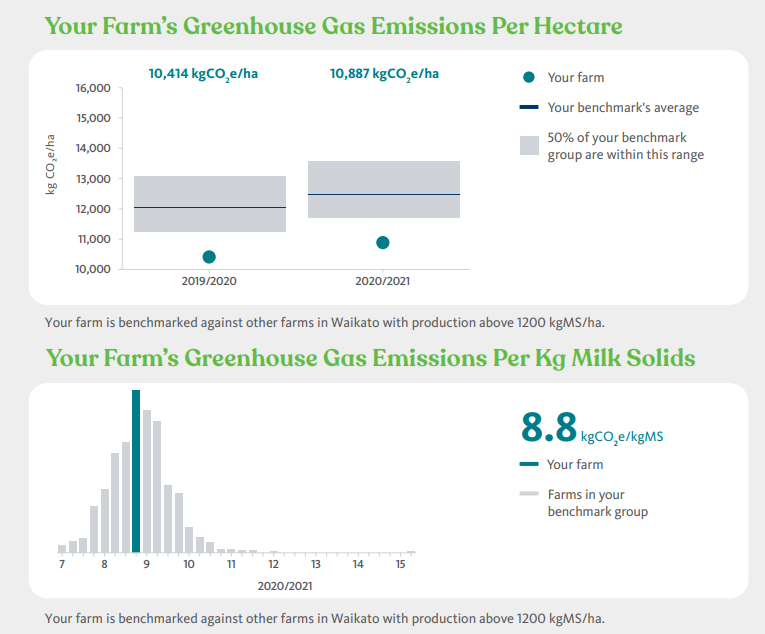
Farm Insights report from Fonterra shows Purchased N surplus reduced to 110kgN/ha compared to 133 kgN/ha in 2019/20 and 169 kgN/ha in 2018/19.
The GHG emissions showed that the BM group in the Waikato along with us increased in 2020/21 compared with 2019/20 as a result of a good production season. We are still tracking lower per hectare than other farms producing more than 1200kgMS/ha.
QUALITY WORKPLACE
Nothing to report
COMMUNITY
If you missed last week’s Farm Focus Day presentation you can view it via https://youtu.be/ItmEsZSsoO8.
Wednesday weekly zoom catchup is on preparing for summer crops and can be found on FB.
PLANNING FOR THE MONTH AHEAD:
Cheers from Jo + Tom
Monday, 13 September 2021
Week ending 13-9-21 farm notes:
FARM PERFORMANCE
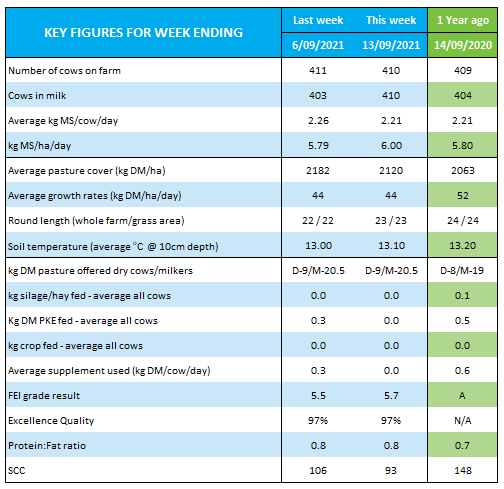
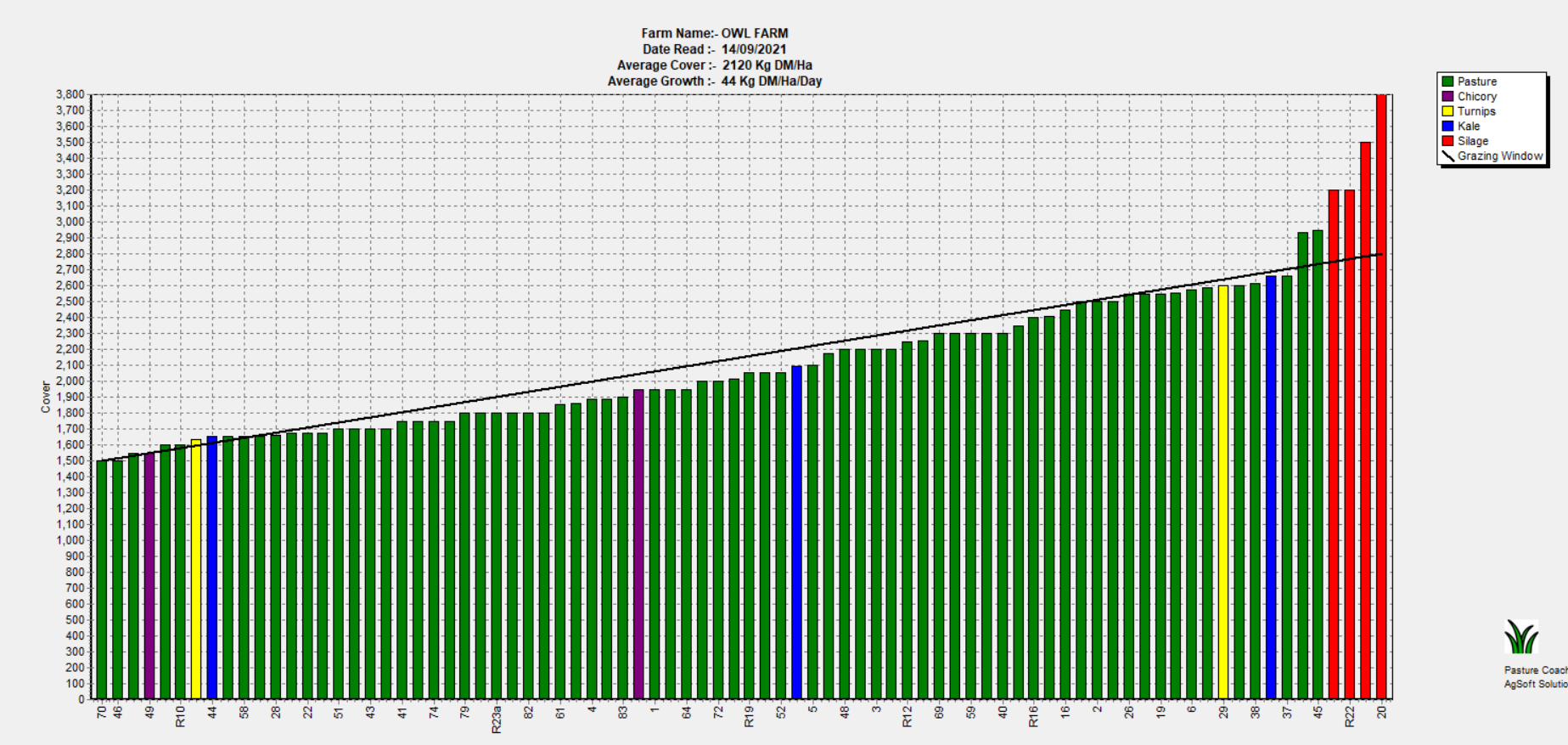
A static pasture growth rate of 44kgDM/ha/day resulted in a drop of APC to 2120 kgDM/ha. Current demand on pasture alone is 58kgDM/day. We have 2 paddocks left that meet our pre-graze target of 2780-2880 kgDM/ha. Calculated as 2.84 cows/ha x 20.5 kgDM/cow intake x 22 day rotation + 1500-1600kgDM/ha residual = 2780-2880kgDM/ha pre graze target.
Our next longest paddocks are 2600kgDM/ha. Options include do nothing and reduce intake while cows continue to mobilise BCS, offer more area per day and speed up the round, reduce demand through early culls, or use supplements to fill the gap.
We have 11ha allocated for cropping due to be sprayed out on Sunday which will increase our stocking rate to 3.08 cows/ha. We have 3 paddocks of annuals that are over 3200kgDM/ha that will be ensiled after spraying rather than pushing the cows to graze them. This will ensure that we get a cleaner paddock prior to sowing in the hope that it will reduce the slug pressure that we face for early crop survival.
With cows at peak production and mating due to start next Wednesday we made the decision to offer 2-3kgDM PK/cow depending on paddock size and while maintaining residuals. This will be reassessed after next week’s farm walk.
We do not want to go any faster as we are currently grazing the paddocks at 2.5 leaf stage and by going into these paddocks earlier we are trading of potential growth. We aim to generate around 55ha of grass silage through the spring at Owl Farm so need to manage pasture to maximise yield and quality. We have applied an average of 46kgN/ha over the last 6 weeks over 2 applications so there are only a few paddocks still to get there second application of N. We then move into strategic use of N based on soil test results to support silage making.
ANIMAL WELL-BEING
Calving finished last week and mating starts next week on Wednesday 22nd. We will be using pre-mating heats along with calving date, BCS, general health to determine alongside our vets which cows will benefit from CIDR use.
Bloat oil started through the dosatron this week. As this is 2 weeks later than we would normally start we are also manually adding bloat oil to the troughs until the dostaron has caught up. We continue to add MgCl to the dosatron and dust with MgO.
Calves are now on a 60/40 mix of milk replacer.
BUSINESS HEALTH
Nothing to report this week.
ENVIRONMENT
We have engaged the services of Wildlands to develop an integrated planting and management plan (IPMP) for Owl Farm. This can be viewed at https://www.owlfarm.nz/environment/farm-environment-plan
The objectives of the IPMP are to:
Prepare an integrated planting plan to guide the management of additional planting areas and previously planted areas within Owl Farm.
The IPMP will include planting for biodiversity, aesthetic, and shade/shelter outcomes.
Include site preparation, fencing, maintenance and monitoring requirements of planted areas.
Include planting schedules of appropriate species for each planting area.
Include a planting and management timeline and a calendar of activities for public events and student engagement.
Incorporate plants grown by students through the Trees for Survival programme and other farm education objectives.
Consider and be consistent with farm operations, the cycleway project, Waikato River restoration and any other farm or adjacent projects. Implementation of this IPMP will protect and enhance ecological features of the farm and help guide future planting and subsequent management. With approximate cost per planting area we are able to include in our budget cycle the cost of plants and have data available for applying for funding.
QUALITY WORKPLACE
Setting up for our AI technician who will be visiting multiple farms has involved QR code for scanning at the shed, boot wash and masks for workspaces safety.
COMMUNITY
Join us tomorrow via Facebook Live or our zoom catchup https://us02web.zoom.us/j/86273812669
to hear our Focus Day 20/21 wagon wheel results. Great chance to get your questions answered about the KPIs we are measuring our performance against.
PLANNING FOR THE MONTH AHEAD:
Cheers from Jo + Tom
Monday, 6 September 2021
Week ending 6-9-21 farm notes:
FARM PERFORMANCE
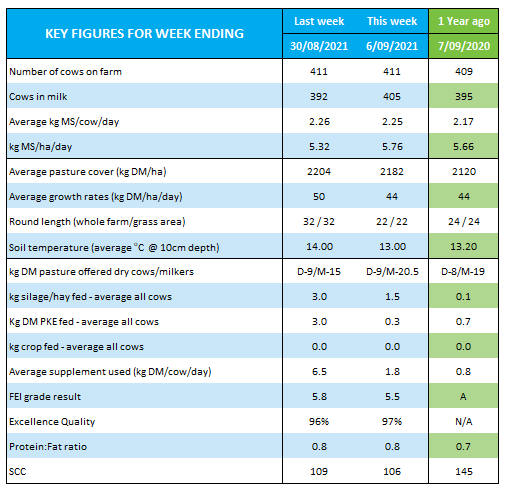
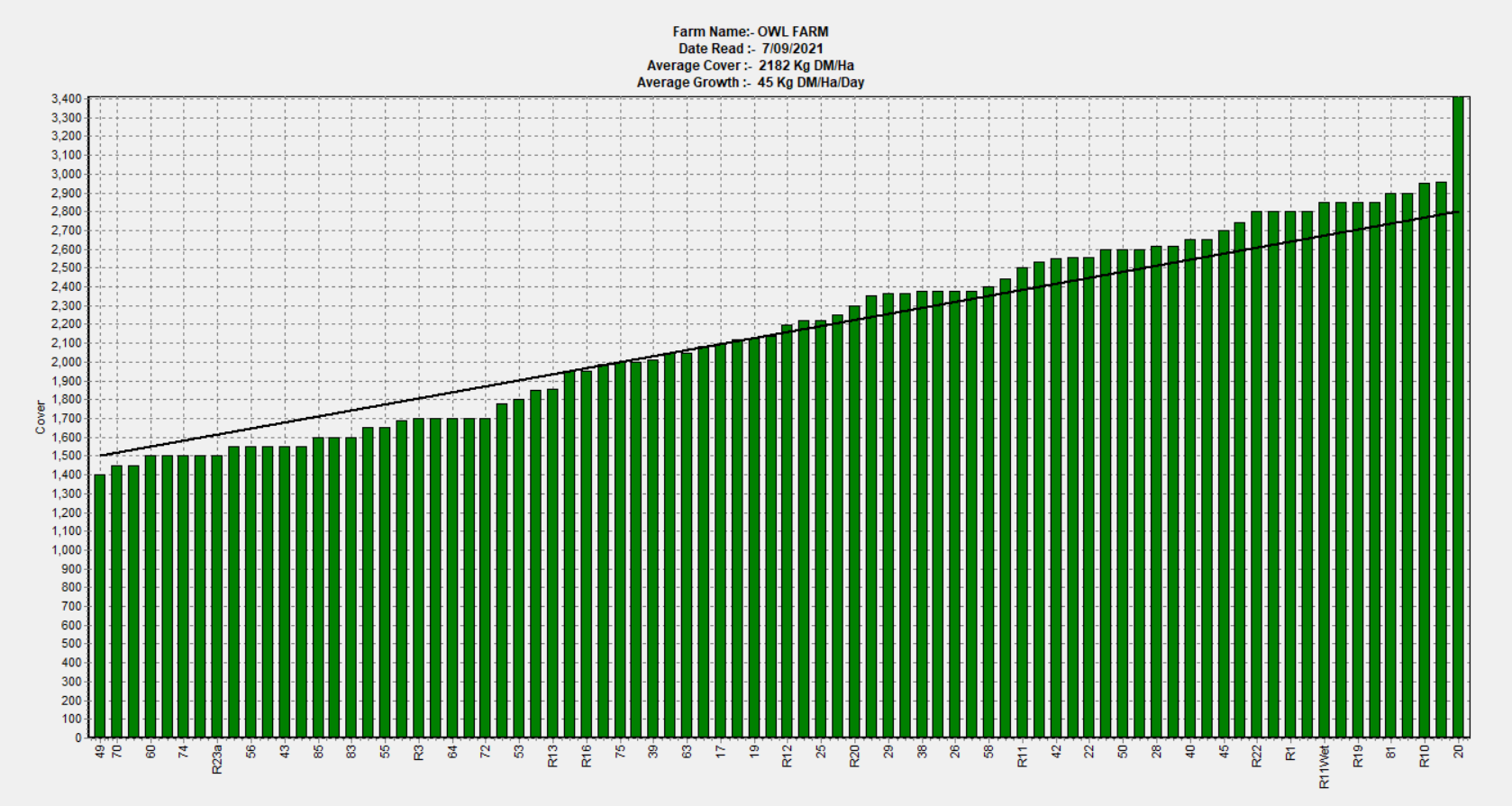
Growth rate dropped to 44kgDM/ha/day and so did APC to 2182 kgDM/ha. Wedge still looks OK but the gap at the end will start to be grazed within 2 weeks so we really need growth rates to step up now. Tom continues to follow behind the cows with our second round application of N. We have used an average of 34.5 kgN/ha to date.
We will finish the last of our PK in the next few days with no more due on contract until December and no grass silage left. We are now grazing 6.6ha/day (including colostrum and springers) which is a 22-day rotation. The training wheels are well and truly off!!! The key is to hold our rotation length pre-mating and ensure that the cows are cleaning up what is offered. We still have a trigger in place if cows are consistently grazing below 1500 kgDM/ha. This would indicate that cows are being underfeed and we have the option to purchase PK at spot prices if we can generate a good milksolids response from the supplement and achieve target residuals. With good cow condition and APC to maximise available growth we shouldn’t need this.
Cows are being offered 20.5 kgDM/day of pasture producing 2.25kgMS/cow. The silage finished last week and the PK was feed to the young herd twice for paddocks that were under target at grazing and offered ad-lib to the colostrum cows.
Milk quality has been great with 97% excellence and SCC of 106,000.
Pasture samples were taken and sent off to the lab for testing today. Our first herd test was carried out last night and this morning.
Unfortunately due to supply chain issues our Plantain only just turned up. It is a challenge now to sow it with fertiliser as planned, as some of the earmarked paddocks are not due for an application for another 3-4 weeks. This will be too late for successful establishment with such fast growing ryegrass swards. For these paddocks we will look to apply in Autumn or the following spring if we can safely store the seed.
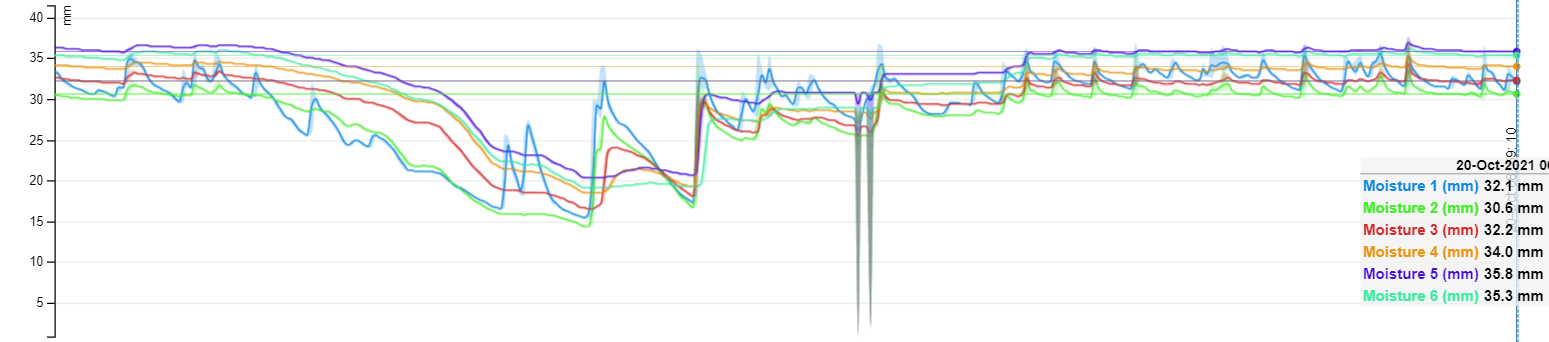
Last year’s rainfall of 836 mm vs the drought the year prior of 752 mm means that although we have had average rainfall for winter of 317 mm our soil moisture levels are very similar to this time last year.
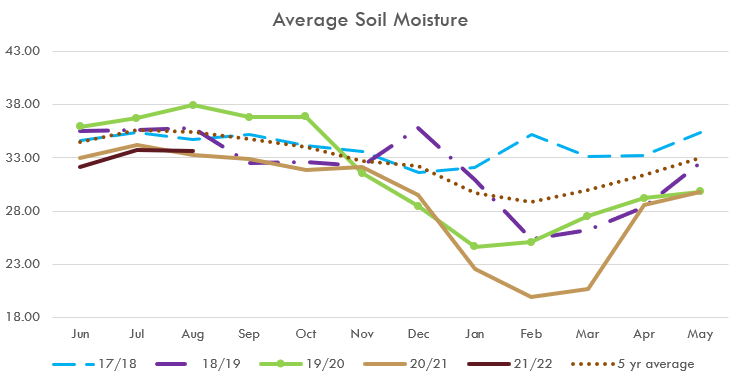 Metservice predicts an average to dry September for us. This would indicate that we need to get our crops in the ground early (as planned) and closely monitor rainfall and soil moisture to predict if we will be able to make the required grass silage at home.
ANIMAL WELL-BEING
Heifer calves are still on 50/50 milk replacer mix. At the moment this equals a 20kg bag which only takes 10 minutes to make up. The most time consuming process is having to weigh out the milk powder as the quantities increase. All wagyu calves have gone and we only have 7 cows left to calve.
Second group of cows have been metri-checked with 4 cows from 130 needing metri-cure. None of the previously treated cows needed re-treating.
Tail painted tonight as we enter the second week of pre-mating heats.
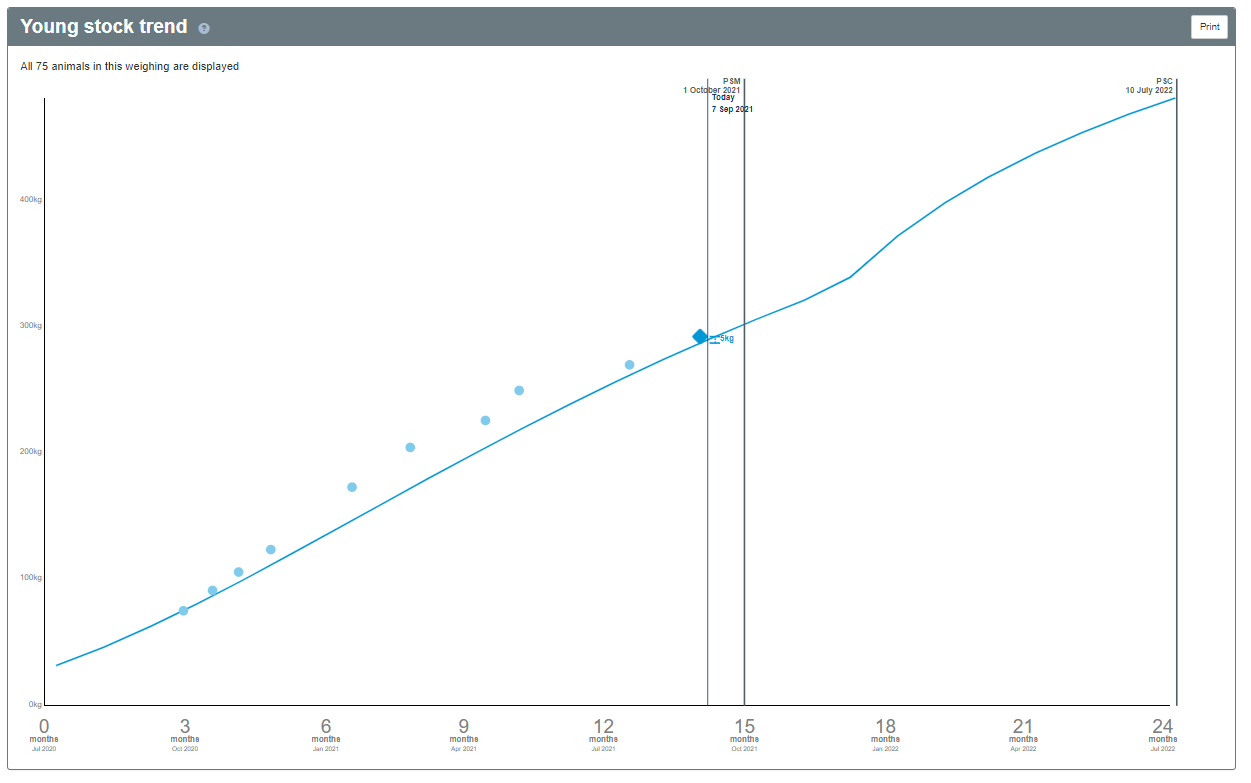
Heifers were weighed at grazing with the mob of 75 now at 292kg and the mob of 15 under-weight now 297 (gained 0.6 – 1.2kg/day on silage and PK at graziers). Only 8 heifers out of the 90 are currently underweight at grazing. Sychrony will start on heifers 11th September at both blocks with sexed semen used on the mob of 75 and the Forward Pack on the mob of 15.
Cows received their pre-mating BCS on the 1st Sept. Herd average was 4.8, heifers were 4.9 and 2 cows were below 4. We are happy with the result which is lower than last year (5.4 on the 17th August 2020) but only 0.2 down from our July BCS average.
BUSINESS HEALTH
Nothing to report.
ENVIRONMENT
As part of our commitment to the Cooperative Difference we partake in a recycling scheme where all our silage and baleage wrap goes to the Plasback scheme. We purchase the recycling bags from FarmSource which the team fill up thoughout the season – this keeps the plastic cleaner and the farm tidier - and ring for a pick up through Slatterys from Matamata. Each liner is $22.50 + GST and pick up is $50 + GST each. More details can be found here: https://slatterycontracting.co.nz/services/silage-wrap-recycling/
QUALITY WORKPLACE
Team all vaccinated this week with a supply of masks when needed as students come back to school on Monday under L2 guidelines.
COMMUNITY
It was great for Tom and I to catchup with some of you last Wednesday on our weekly zoom. For those of you interested in our journey from 34% to 71% purposeful breeding objectives for our calves – join us at 11am Wednesday 8th September to chat to us along with LIC as we discuss the pros and cons and next steps for the coming mating. This is also a great chance to ask questions about things you’ve read in our weekly updates. https://us02web.zoom.us/j/86273812669
We will be hosting our Focus Day presentation of wagon wheel KPIs on FB live event – click “going” to the event on Facebook to be kept up to date. More details to come.
PLANNING FOR THE MONTH AHEAD:
Cheers from Jo + Tom
 Home
Home  OwlFarm Home
 News
News  Images
 Videos
 Milk Production
 Animal Health
 Pasture Production
 Supplementary Use
 Nitrogen & Gibberellic Acid Use
 Climate
 Correlation & Extra data
 Ops Manual
  Financials
  Health